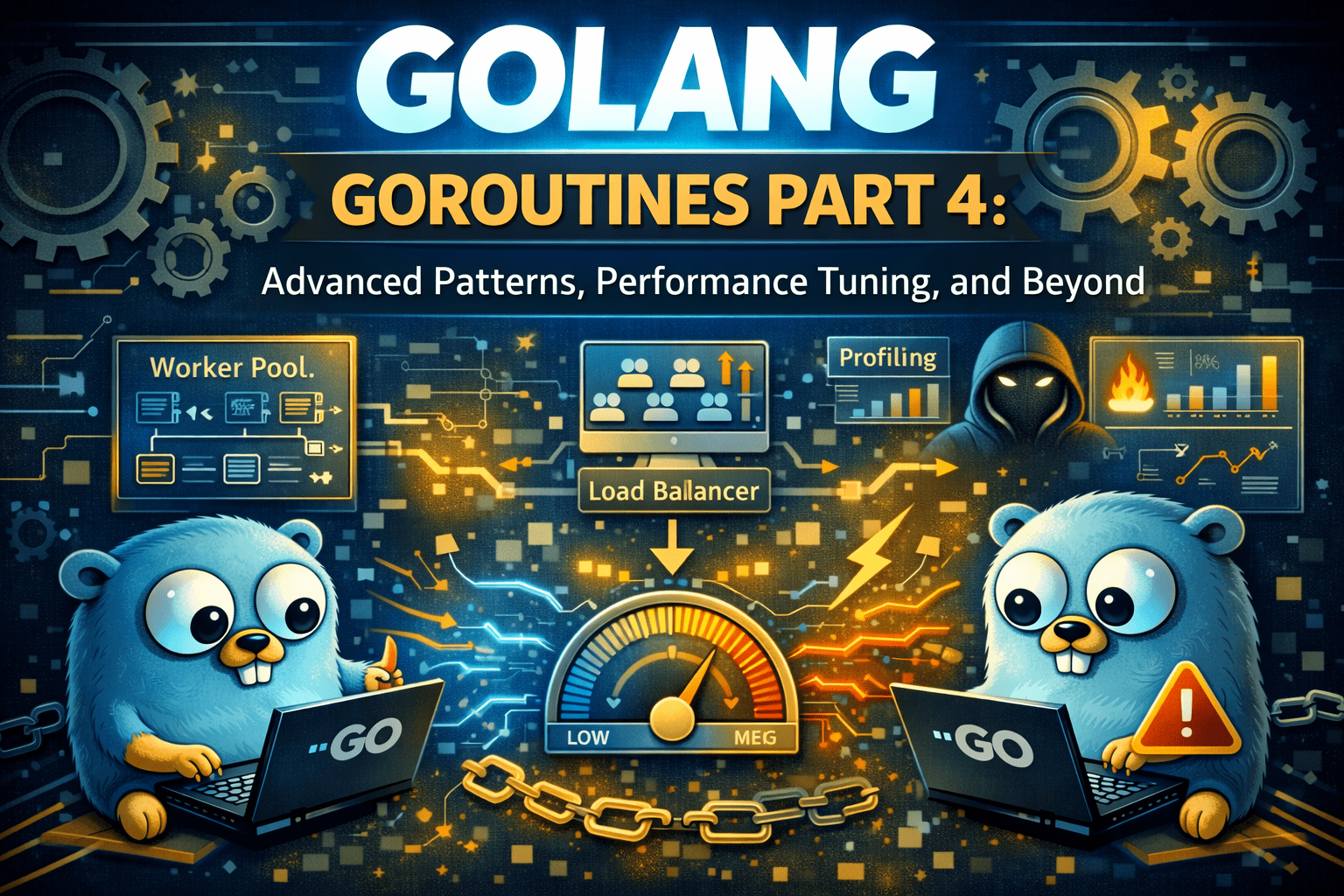

Welcome back to our expanding series on Golang Goroutines! Building on the foundations from Part 1 (basics and creation), Part 2 (channels and communication), and Part 3 (advanced synchronization and pitfalls), we’re now venturing into more sophisticated territory. This Part 4 focuses on advanced concurrency patterns, performance optimization, additional sync primitives, and integrations with modern Go features.
These topics address real-world scalability challenges, drawing from official Go talks like “Go Concurrency Patterns” and community best practices. We’ll include code examples to make them actionable. If you’re building high-performance systems, this is where concurrency shines. Let’s dive in!
Additional Sync Primitives for Specialized Use Cases
Beyond mutexes and WaitGroups, the sync package offers tools for niche scenarios. These complement channels by handling specific coordination needs efficiently.
sync.Once: Lazy Initialization
sync.Once ensures a function runs exactly once, no matter how many goroutines call it-perfect for singletons or setup code.
Example: Initializing a shared resource.
package main
import (
    "fmt"
    "sync"
)
var once sync.Once
var config string
func loadConfig() {
    config = "Loaded configuration"
    fmt.Println("Config loaded once")
}
func getConfig() string {
    once.Do(loadConfig)
    return config
}
func main() {
    var wg sync.WaitGroup
    for i := 0; i < 5; i++ {
        wg.Add(1)
        go func() {
            defer wg.Done()
            fmt.Println(getConfig())
        }()
    }
    wg.Wait()
}
Output:
Config loaded once
Loaded configuration
Loaded configuration
... (repeated)
Only one goroutine executes loadConfig; others wait and reuse the result.
sync.Cond: Signaling and Broadcasting
sync.Cond works with a mutex to notify waiting goroutines of state changes, like a more flexible WaitGroup for conditional waits.
Example: A queue with notifications.
package main
import (
    "fmt"
    "sync"
    "time"
)
var (
    mu    sync.Mutex
    cond  = sync.NewCond(&mu)
    queue []int
)
func producer() {
    for i := 1; i <= 3; i++ {
        mu.Lock()
        queue = append(queue, i)
        cond.Signal()  // Notify one waiter
        mu.Unlock()
        time.Sleep(time.Second)
    }
}
func consumer(id int) {
    mu.Lock()
    for len(queue) == 0 {
        cond.Wait()  // Wait until signaled
    }
    item := queue[0]
    queue = queue[1:]
    mu.Unlock()
    fmt.Printf("Consumer %d got %d\n", id, item)
}
func main() {
    go producer()
    for i := 1; i <= 3; i++ {
        go consumer(i)
    }
    time.Sleep(4 * time.Second)
}
Use cond.Broadcast() to notify all waiters. This is useful for event-driven systems.
sync.Map and sync.Pool
- sync.Map: A goroutine-safe map for concurrent reads/writes without a global mutex. Ideal for caches.
var m sync.Map m.Store("key", "value") val, ok := m.Load("key")- sync.Pool: Temporary object pools to reduce allocations and GC pressure (e.g., for buffers)
var pool = sync.Pool{New: func() any { return make([]byte, 1024) }} buf := pool.Get().([]byte) // Use buf... pool.Put(buf) // RecycleThese primitives shine in performance-critical code.
Advanced Concurrency Patterns
Go’s concurrency enables elegant patterns for complex workflows. Here are key ones not covered earlier.
Pipeline Pattern: Staged Processing
Pipelines chain goroutines via channels for sequential data transformation, like ETL processes.
Example: Square numbers, then filter evens.
package main
import "fmt"
func generator(ch chan<- int) {
    for i := 1; i <= 5; i++ {
        ch <- i
    }
    close(ch)
}
func squarer(in <-chan int, out chan<- int) {
    for v := range in {
        out <- v * v
    }
    close(out)
}
func filterEven(in <-chan int, out chan<- int) {
    for v := range in {
        if v%2 == 0 {
            out <- v
        }
    }
    close(out)
}
func main() {
    gen := make(chan int)
    sq := make(chan int)
    ev := make(chan int)
    go generator(gen)
    go squarer(gen, sq)
    go filterEven(sq, ev)
    for v := range ev {
        fmt.Println(v)  // 4, 16
    }
}
Scale by adding stages or parallelizing within stages.
Fan-In/Fan-Out and Replicated Requests
- Fan-Out: Distribute work to multiple workers (as in worker pools).
- Fan-In: Merge multiple channels into one using a multiplexer. Example Fan-In:
func merge(chs ...<-chan int) <-chan int {
    out := make(chan int)
    var wg sync.WaitGroup
    wg.Add(len(chs))
    for _, ch := range chs {
        go func(c <-chan int) {
            defer wg.Done()
            for v := range c {
                out <- v
            }
        }(ch)
    }
    go func() { wg.Wait(); close(out) }()
    return out
}- Replicated Requests: Send a request to multiple sources and take the fastest response.
func replicatedQuery(sources []string) string {
    ch := make(chan string, len(sources))
    for _, src := range sources {
        go func(s string) { ch <- query(s) }(src)  // Hypothetical query func
    }
    return <-ch  // First response wins
}
Other Patterns: Or-Done, Leaky Bucket, and Pub/Sub
- Or-Done: Merge channels and close on first completion.
- Leaky Bucket: Rate limiting with a buffered channel and timer.
bucket := make(chan struct{}, 10)  // Capacity = rate
go func() {
    for range time.Tick(time.Second) {
        select {
        case bucket <- struct{}{}:
        default:  // Full, leak (drop)
        }
    }
}()
// To send: <-bucket; doWork()- Pub/Sub: A publisher channel fanned out to subscribers via goroutines.
For full implementations, refer to Go’s blog on advanced patterns.
Performance Tuning and Runtime Insights
Optimize concurrency with Go’s tools and runtime knowledge.
Scheduler and GOMAXPROCS
- Set runtime.GOMAXPROCS(runtime.NumCPU()) for parallelism.
- Understand preemption: Goroutines yield on syscalls or after ~10ms.
- Tune for CPU-bound vs. I/O-bound: Use more goroutines for I/O.
Profiling and Tracing
- CPU/Memory: go tool pprof on profiles from runtime/pprof.
- Tracing: go test -trace=trace.out or runtime/trace for visualizing goroutine scheduling.
- Benchmark: Use testing.B with -bench and -cpu flags.
Example: Add tracing to your program.
import "runtime/trace"
trace.Start(os.Stderr)
defer trace.Stop()
Memory Model
Go guarantees happens-before relationships (e.g., channel sends happen before receives). Use this to avoid races without locks.
Integrations and Modern Features
Concurrency with Generics (Go 1.18+)
Type-safe channels and patterns:
type SafeChan[T any] struct {
    ch chan T
}
func NewSafeChan[T any](size int) *SafeChan[T] {
    return &SafeChan[T]{ch: make(chan T, size)}
}
Real-World Integrations
- HTTP Servers: Use goroutines per request; limit with semaphores from golang.org/x/sync/semaphore.
- Databases: Pool connections concurrently.
- gRPC/Streaming: Channels for bidirectional streams.
Extensions like singleflight.Group deduplicate calls.
Best Practices and When Not to Use Concurrency
- Monitor goroutine count with runtime.NumGoroutine().
- Avoid over-parallelism; profile first.
- For pure CPU tasks, consider runtime.LockOSThread() or external libraries.
- Test rigorously: Use race detector, fuzzing, and chaos testing.
Conclusion
This Part 4 expands our series with advanced patterns, sync tools, and tuning techniques to handle complex, performant systems. In Part 5 which is the latest part we’ll cover Testing Concurrency and Domain-Specific Applications.