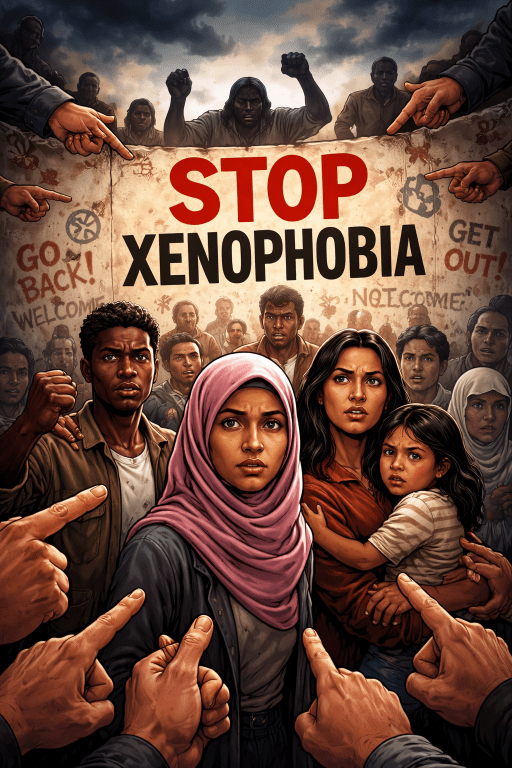
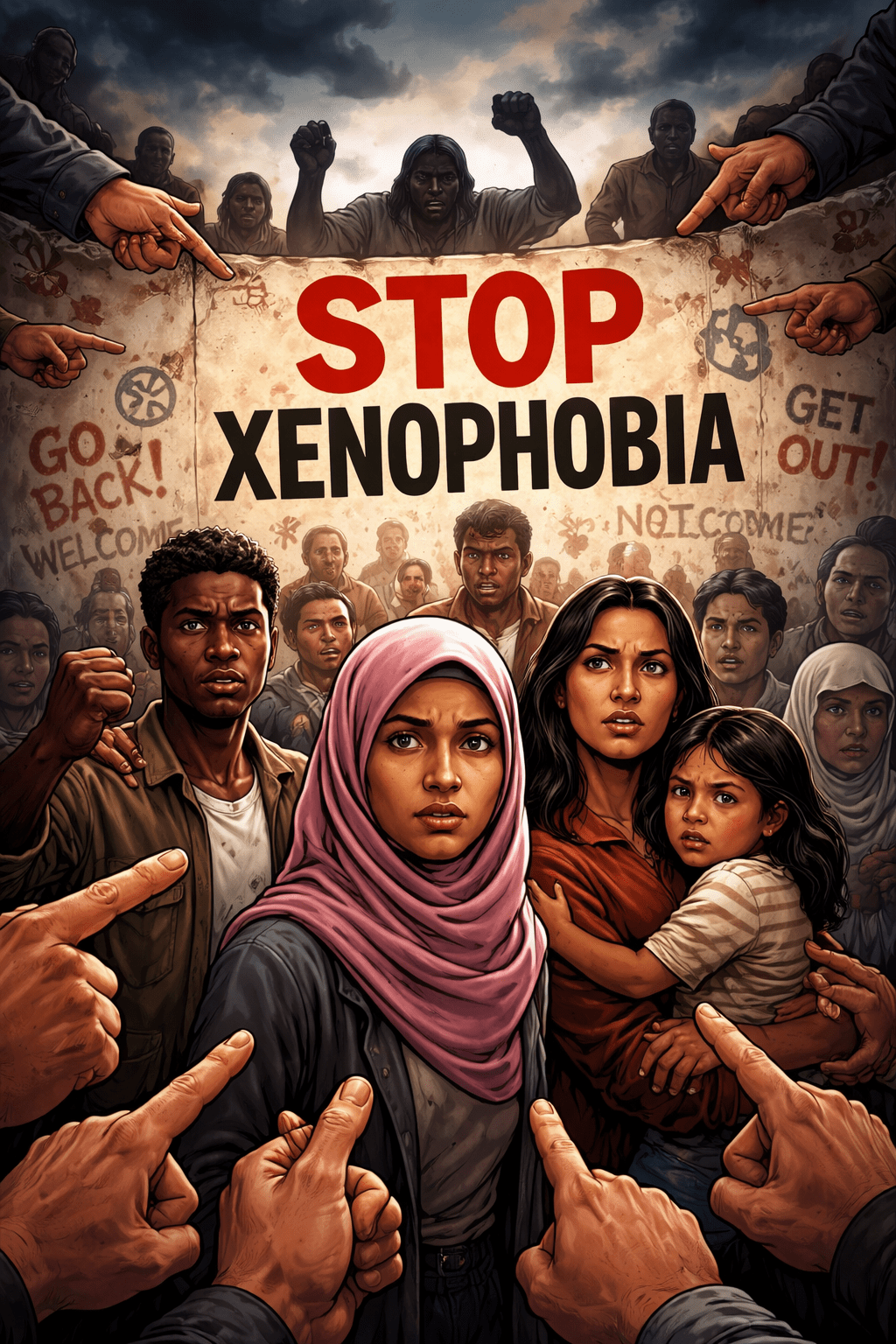

Xenophobia – the fear, hatred, or prejudice against people from other countries or cultures – is one of the oldest and most persistent social problems in human history. In today’s hyper-connected world, it still fuels everything from casual stereotypes to violent hate crimes and far-reaching political movements.
This article explains exactly what xenophobia is, where it comes from, how it manifests, and – most importantly – what we can do about it.
What Does “Xenophobia” Actually Mean?
The word comes from Greek:
- Xenos = stranger or foreigner
- Phobos = fear
So literally, xenophobia means “fear of strangers/foreigners.”
It is distinct from racism (though the two often overlap). You can be xenophobic toward people of the same race but different nationality or culture (e.g., English people disliking French people, or South Koreans disliking North Korean defectors). Conversely, you can be racist toward people of different races within your own country without being particularly xenophobic.
Common manifestations include:
- Believing immigrants “take jobs” or “destroy culture”
- Mocking accents or foreign names
- Supporting policies that restrict immigration or target specific nationalities
- Physical or verbal attacks on perceived foreigners
A Short History of Xenophobia
Xenophobia is older than nations themselves.
- Ancient Athens had periods of intense suspicion toward “metics” (foreign residents).
- Medieval Europe regularly expelled or massacred Jewish and Muslim minorities.
- The 19th century saw “Yellow Peril” hysteria against Chinese immigrants in the US and Australia.
- The 20th century gave us the Chinese Exclusion Act (1882), Jewish refugee ships turned away before and during the Holocaust, Japanese-American internment (1942–1945), and South African apartheid’s treatment of other African nationals.
In the 21st century we’ve seen:
- Post-9/11 Islamophobia in the West
- Anti-Mexican and anti-Muslim rhetoric during the 2016 Trump campaign
- Brexit’s heavy anti-Polish and anti-Romanian sentiment
- Anti-Chinese attacks during the COVID-19 pandemic
- Recent surges against Venezuelans in South America, Rohingya in Myanmar, Ukrainians in parts of Russia (and vice versa), etc.
Why Does Xenophobia Happen? The Main Drivers
- Economic Anxiety
When people feel financially insecure, they often scapegoat outsiders. “They’re taking our jobs/housing/benefits” is a simple narrative that feels true even when evidence shows immigrants usually grow the economy. - Cultural Threat Perception
Rapid demographic or cultural change can trigger a defensive reaction: “We are being replaced” or “Our way of life is disappearing.” This is the core of “Great Replacement” conspiracy theories. - In-Group/Out-Group Psychology
Humans evolved in small tribes. Our brains are wired to quickly categorize “us” vs “them” and to feel suspicion toward “them.” Xenophobia is tribalism on a national scale. - Media & Political Exploitation
Sensational headlines and politicians deliberately stoke fear for clicks or votes. Repeated messages that “immigrants = crime” or “refugees = terrorists” sink deep even when statistics show the opposite. - Lack of Contact
The less you actually know people from another culture, the easier it is to believe negative stereotypes. This is called the “contact hypothesis” in reverse.
Real-World Consequences of Xenophobia
- Violence and Hate Crimes – From lynchings of Italian immigrants in 1890s Louisiana to acid attacks on Bolivians in Argentina or murders of Indian students in Australia.
- Discrimination – Foreign-sounding names get fewer job callbacks; refugees face bullying in schools; entire communities live in fear.
- Bad Policy – Travel bans, border walls, asylum restrictions, citizenship stripped from long-term residents (see Dominican Republic vs Haitians 2013).
- Lost Talent & Economic Damage – Countries that welcome immigrants (Canada, Australia pre-2020s) consistently outperform those that don’t.
- Social Division – It poisons everyday interactions and makes diverse societies harder to hold together.
Is It Getting Worse?
Yes and no.
The internet spreads both xenophobia (through echo-chamber subreddits, TikTok propaganda, and coordinated troll campaigns) and exposure to other cultures (K-pop stans, international gaming friends, remote coworkers).
Global migration is at historic highs, which naturally creates friction, but acceptance of diversity in most Western countries is also higher than in the 1950s–1980s.
How to Fight Xenophobia – Practical Steps
At the personal level:
- Call out xenophobic “jokes” – they normalize prejudice.
- Actively seek out friends, colleagues, or neighbors from different backgrounds.
- Share positive stories of immigrants and refugees.
- Learn basic phrases in other languages – it humanizes people instantly.
- Examine your own assumptions. Ask: “Would I think this if the person was from my country?”
At the community/school/work level:
- Organize cultural exchange potlucks, international film nights, etc.
- Invite guest speakers who are immigrants to tell their stories.
- Teach media literacy – show how headlines distort reality.
At the policy level:
- Support evidence-based immigration systems (points-based, merit-based, humanitarian).
- Demand politicians stop scapegoating minorities for votes.
- Fund integration programs properly – language classes, job placement, mental health support.
Final Thought
Xenophobia thrives on ignorance and fear. It shrinks when people meet each other as individuals rather than as “foreigners.”
Every time you choose curiosity over suspicion, welcome over rejection, or facts over slogans, you weaken xenophobia a little bit more.
The world is not becoming “smaller” – it’s becoming more mixed. We can either fear that reality or embrace it.
The choice is ours.
What’s your experience with xenophobia – either facing it or witnessing it?