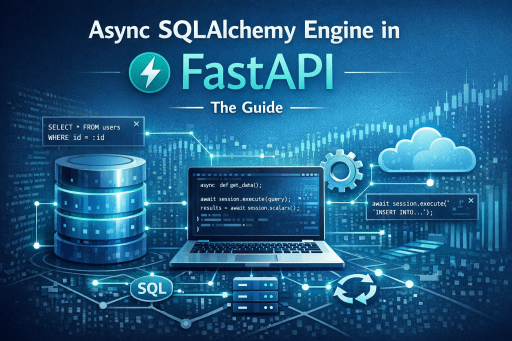

If you’ve been building FastAPI applications, you probably already appreciate its async-first nature – making it a great choice for high-performance APIs.
But if your database layer isn’t async-friendly, you’re still bottlenecked by synchronous I/O. That’s where Async SQLAlchemy comes in.
In this guide, we’ll cover:
- Why use Async SQLAlchemy with FastAPI
- Core concepts of SQLAlchemy’s async API
- How to set up an async engine & session
- Writing async database queries
- Handling transactions
- Common pitfalls & best practices
- Full working example
Why Go Async with SQLAlchemy in FastAPI?
By default, SQLAlchemy is blocking. In an async web app, a blocking database call means your event loop waits — preventing other requests from being handled until the query completes.
With Async SQLAlchemy:
- Queries don’t block the event loop
- Multiple requests can be served concurrently
- Better scalability under load
- Works with async DB drivers like
asyncpg(PostgreSQL),aiosqlite(SQLite), oraiomysql(MySQL)
How Async SQLAlchemy Works
SQLAlchemy introduced the async engine in version 1.4 and improved it in 2.0.
Key changes from sync to async:
- Use
create_async_engine()instead ofcreate_engine() - Sessions are
AsyncSession - All DB calls must be awaited
- DB drivers must support async (e.g.,
asyncpgfor PostgreSQL)
Installing Requirements
For PostgreSQL:
pip install fastapi[all] sqlalchemy[asyncio] asyncpg
For SQLite (async testing):
pip install fastapi[all] sqlalchemy[asyncio] aiosqlite
Setting up Async SQLAlchemy with FastAPI
Create the database engine:
Create a file named database.py and put these content in it:
from sqlalchemy.ext.asyncio import create_async_engine, AsyncSession
from sqlalchemy.orm import sessionmaker, declarative_base

DATABASE_URL = "postgresql+asyncpg://user:password@localhost:5432/mydb"
engine = create_async_engine(
    DATABASE_URL,
    echo=True,
    future=True, # Use future=True for SQLAlchemy 2.0 style
)
AsyncSessionLocal = sessionmaker(
    bind=engine,
    class_=AsyncSession,
    expire_on_commit=False,
)
Base = declarative_base()
Dependency for Async Session in FastAPI:
Create a file named “deps.py” and put these contents in it:
from app.database import AsyncSessionLocal
from sqlalchemy.ext.asyncio import AsyncSession

async def get_session() -> AsyncSession:
    async with AsyncSessionLocal() as session:
        yield session
Create a Model:
Create a file named “models.py” besides “database.py” and “deps.py“:
from sqlalchemy import Column, Integer, String
from app.database import Base

class User(Base):
    __tablename__ = "users"
    id = Column(Integer, primary_key=True, index=True)
    name = Column(String, index=True)
    email = Column(String, unique=True, index=True)
Initialize Database Tables:
Create a file named “init_db.py“:
import asyncio
from app.database import Base, engine
from app.models import * # noqa: F401, F403
async def init_models():
    async with engine.begin() as conn:
        # Create all tables in the database
        await conn.run_sync(Base.metadata.create_all)

if __name__ == "__main__":
    asyncio.run(init_models())
Writing Async Queries in FastAPI:
Create a file named “main.py“:
from fastapi import Depends, FastAPI
from sqlalchemy import select
from sqlalchemy.ext.asyncio import AsyncSession
from sqlalchemy.exc import IntegrityError
from fastapi import HTTPException
from app.deps import get_session
from app.models import User, UserCreate, UserResponse

from contextlib import asynccontextmanager
@asynccontextmanager
async def lifespan(app: FastAPI):
    from app.init_db import init_models
    await init_models()
    yield

app = FastAPI(lifespan=lifespan)

@app.post("/users/", response_model=UserResponse)
async def create_user(
    user: UserCreate, session: AsyncSession = Depends(get_session)
):
    try:
        async with session.begin():  # Auto commit/rollback
            new_user = User(**user.model_dump())
            session.add(new_user)
        # refresh after commit if you need DB-generated values (id, timestamps, etc.)
        await session.refresh(new_user)
        return new_user
    except IntegrityError:
        raise HTTPException(
            status_code=400,
            detail="User with provided unique fields already exists."
        )

@app.get("/users/", response_model=list[UserResponse])
async def list_users(session: AsyncSession = Depends(get_session)):
    result = await session.execute(select(User))
    users = result.scalars().all()
    return users
Postgres Setup:
Create a docker compose file for PostgreSQL:
services:
  db:
    image: postgres:latest
    environment:
      POSTGRES_USER: user
      POSTGRES_PASSWORD: password
      POSTGRES_DB: mydb
    ports:
      - "5432:5432"
    volumes:
      - db_data:/var/lib/postgresql/data

volumes:
  db_data:
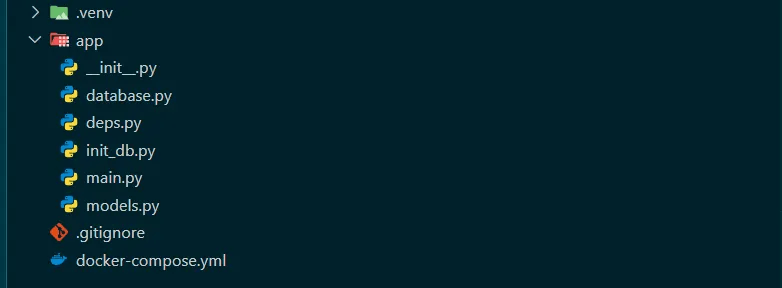
Project Structure:
Your project’s structure should look like this:
Running the Project
To run the project, execute these commands in order:
- docker compose up –build -d
- uvicorn app.main:app –host=0.0.0.0
Testing the Project
First create a user using this command:
curl --location 'http://localhost:8000/users/' \
--header 'Content-Type: application/json' \
--data-raw '{
    "name": "Test User 1",
    "email": "[email protected]"
}'
Then get all users using this curl command:
curl --location 'http://localhost:8000/users/'
Common Pitfalls
- Mixing Sync and Async Engines
Don’t callcreate_engine()in async apps — it will block. - Using Non-Async Drivers
Always use async-supported drivers likeasyncpg,aiosqlite, oraiomysql. - Forgetting
await
Any ORM query or commit must be awaited. - Not Managing Sessions Properly
Always close sessions withasync withortry/finally.
Best Practices
- One session per request — never reuse across requests.
- Use
expire_on_commit=Falsefor better async behavior. - Keep queries short — async helps with concurrency, not query speed.
- Use Pydantic models for request/response validation.
- For large datasets, use
stream()or pagination.
Performance Boost
Switching from sync to async SQLAlchemy can yield significant improvements under load.
In testing with locust, async DB queries in FastAPI handled 3–5x more requests/sec for the same hardware compared to sync queries.
Final Thoughts
Async SQLAlchemy in FastAPI isn’t magic — your queries still take time — but it eliminates unnecessary blocking, making your API far more scalable.
If you’re already running FastAPI and using SQLAlchemy, the migration is straightforward: swap to create_async_engine, use async sessions, and ensure your DB driver supports async.