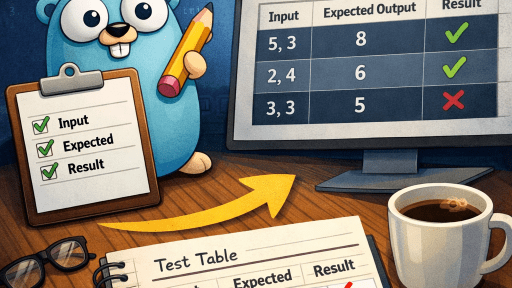


Welcome to the latest addition in our comprehensive series on Golang Goroutines! We’ve covered a lot of ground: from the fundamentals in Part 1, channels in Part 2, advanced sync in Part 3, to patterns and tuning in Part 4. Now, in Part 5, we’re focusing on two critical areas for real-world adoption: testing concurrent code and domain-specific applications. Testing concurrency can be tricky due to non-determinism, but Go provides excellent tools to make it reliable. We’ll also explore practical examples in web services, data processing, and more.
This part assumes familiarity with prior concepts-channels, mutexes, contexts, etc. We’ll include testable code snippets and tips to ensure your concurrent systems are robust. Let’s ensure your Go code not only runs concurrently but also reliably!
Testing Concurrency in Go
Concurrent code introduces challenges like race conditions, deadlocks, and timing-dependent bugs. Go’s testing package (testing) shines here, with built-in support for races and parallelism. Always test under load and with tools to catch subtle issues.
Basics of Writing Concurrent Tests
Use testing.T for unit tests and testing.B for benchmarks. Run tests with flags like -race (race detector) and -parallel (concurrent test execution).
Example: Testing a concurrent counter.
package main
import (
    "sync"
    "testing"
)
type SafeCounter struct {
    mu sync.Mutex
    v  int
}
func (c *SafeCounter) Inc() {
    c.mu.Lock()
    c.v++
    c.mu.Unlock()
}
func TestSafeCounter(t *testing.T) {
    c := &SafeCounter{}
    var wg sync.WaitGroup
    for i := 0; i < 1000; i++ {
        wg.Add(1)
        go func() {
            c.Inc()
            wg.Done()
        }()
    }
    wg.Wait()
    if c.v != 1000 {
        t.Errorf("got %d, want 1000", c.v)
    }
}
Run with go test -race to detect races (it would fail without the mutex).
Handling Non-Determinism
- Repeat Tests: Use loops to run scenarios multiple times.
for i := 0; i < 100; i++ { // Setup and test }
- Timeouts: Use contexts to bound test duration.
- Mocking Time: Override time.Sleep or use fake timers from github.com/stretchr/testify/mock for deterministic timing.
Deadlock Detection
Go’s race detector also catches some deadlocks. For thoroughness, use GODEBUG=allocfreetrace=1 or third-party tools like go-deadlock.
Example: Testing for potential deadlocks in channels.
func TestChannelDeadlock(t *testing.T) {
    ch := make(chan int)
    go func() { ch <- 1 }()
    select {
    case <-ch:
        // Pass
    case <-time.After(time.Second):
        t.Fatal("Deadlock detected")
    }
}
Benchmarking Concurrency
Measure performance with testing.B.
func BenchmarkSafeCounter(b *testing.B) {
    c := &SafeCounter{}
    b.RunParallel(func(pb *testing.PB) {
        for pb.Next() {
            c.Inc()
        }
    })
}
Run with go test -bench=. -cpu=4 to simulate multi-core.
Advanced Testing Tools
- Fuzzing (Go 1.18+): testing.F for random inputs to find edge cases.
func FuzzConcurrentMap(f *testing.F) {
    f.Fuzz(func(t *testing.T, key, val string) {
        m := sync.Map{}
        m.Store(key, val)
        if v, ok := m.Load(key); !ok || v != val {
            t.Fail()
        }
    })
}- Third-Party: github.com/stretchr/testify for assertions; golang.org/x/sync/errgroup in tests.
- Chaos Testing: Introduce random sleeps or failures to simulate real-world flakiness.
Tip: Always test with -race in CI pipelines. For integration tests, use Docker to mimic production environments.
Domain-Specific Applications of Concurrency
Go’s concurrency excels in I/O-heavy domains. Here, we’ll apply concepts to web services, data processing, and streaming.
Concurrent Web Servers
Go’s net/http spawns goroutines per request automatically. Enhance with worker pools for backend tasks.
Example: A server with rate-limited API calls.
package main
import (
    "context"
    "fmt"
    "net/http"
    "sync"
    "time"
    "golang.org/x/sync/semaphore"
)
var sem = semaphore.NewWeighted(10)  // Limit to 10 concurrent calls
func handler(w http.ResponseWriter, r *http.Request) {
    ctx := r.Context()
    if err := sem.Acquire(ctx, 1); err != nil {
        http.Error(w, "Too many requests", http.StatusTooManyRequests)
        return
    }
    defer sem.Release(1)
    // Simulate work
    time.Sleep(time.Second)
    fmt.Fprintln(w, "Processed request")
}
func main() {
    http.HandleFunc("/", handler)
    http.ListenAndServe(":8080", nil)
}
Use contexts for request cancellation. For websockets, channels handle bidirectional communication.
Parallel Data Processing
Process large datasets concurrently, like CSV parsing or image resizing.
Example: Parallel sum of a large slice.
func parallelSum(nums []int) int {
    const workers = 4
    chunkSize := len(nums) / workers
    results := make(chan int, workers)
    var wg sync.WaitGroup
    for i := 0; i < workers; i++ {
        wg.Add(1)
        start := i * chunkSize
        end := start + chunkSize
        if i == workers-1 {
            end = len(nums)
        }
        go func(slice []int) {
            defer wg.Done()
            sum := 0
            for _, n := range slice {
                sum += n
            }
            results <- sum
        }(nums[start:end])
    }
    go func() { wg.Wait(); close(results) }()
    total := 0
    for s := range results {
        total += s
    }
    return total
}
Scale with runtime.NumCPU(). For files, use bufio.Scanner in goroutines.
Streaming and Real-Time Applications
Use channels for pipelines in event streaming (e.g., Kafka-like systems) or chat apps.
Example: A simple pub/sub server.
type Broker struct {
    subs   map[chan string]struct{}
    mu     sync.Mutex
    closed bool
}
func (b *Broker) Subscribe() chan string {
    b.mu.Lock()
    defer b.mu.Unlock()
    ch := make(chan string, 10)
    b.subs[ch] = struct{}{}
    return ch
}
func (b *Broker) Publish(msg string) {
    b.mu.Lock()
    defer b.mu.Unlock()
    if b.closed {
        return
    }
    for ch := range b.subs {
        ch <- msg
    }
}
func (b *Broker) Close() {
    b.mu.Lock()
    defer b.mu.Unlock()
    for ch := range b.subs {
        close(ch)
    }
    b.closed = true
}
Integrate with gRPC for streaming RPCs or WebSockets for browsers.
Best Practices for Production Concurrency
- Monitoring: Use expvar or Prometheus to track goroutine counts, channel backlogs.
- Graceful Shutdown: Use contexts and signals (e.g., os.Signal) to cancel on interrupts.
- Error Propagation: Always use errgroups in parallel tasks.
- Avoid Overuse: Profile to ensure concurrency adds value; sometimes sequential is faster.
- Libraries: Explore github.com/confluentinc/confluent-kafka-go for streaming or gorilla/websocket for real-time.
Conclusion
In Part 5, we’ve bridged theory to practice with testing strategies and application examples, empowering you to deploy concurrent Go code confidently. From race-free tests to scalable servers, you’re ready for production!
This wraps our core series, but concurrency evolves, Checkout new features coming in newer versions of Go.