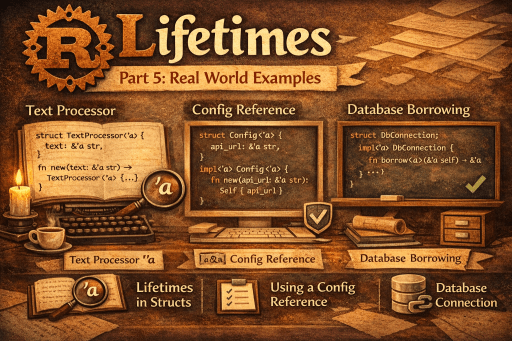
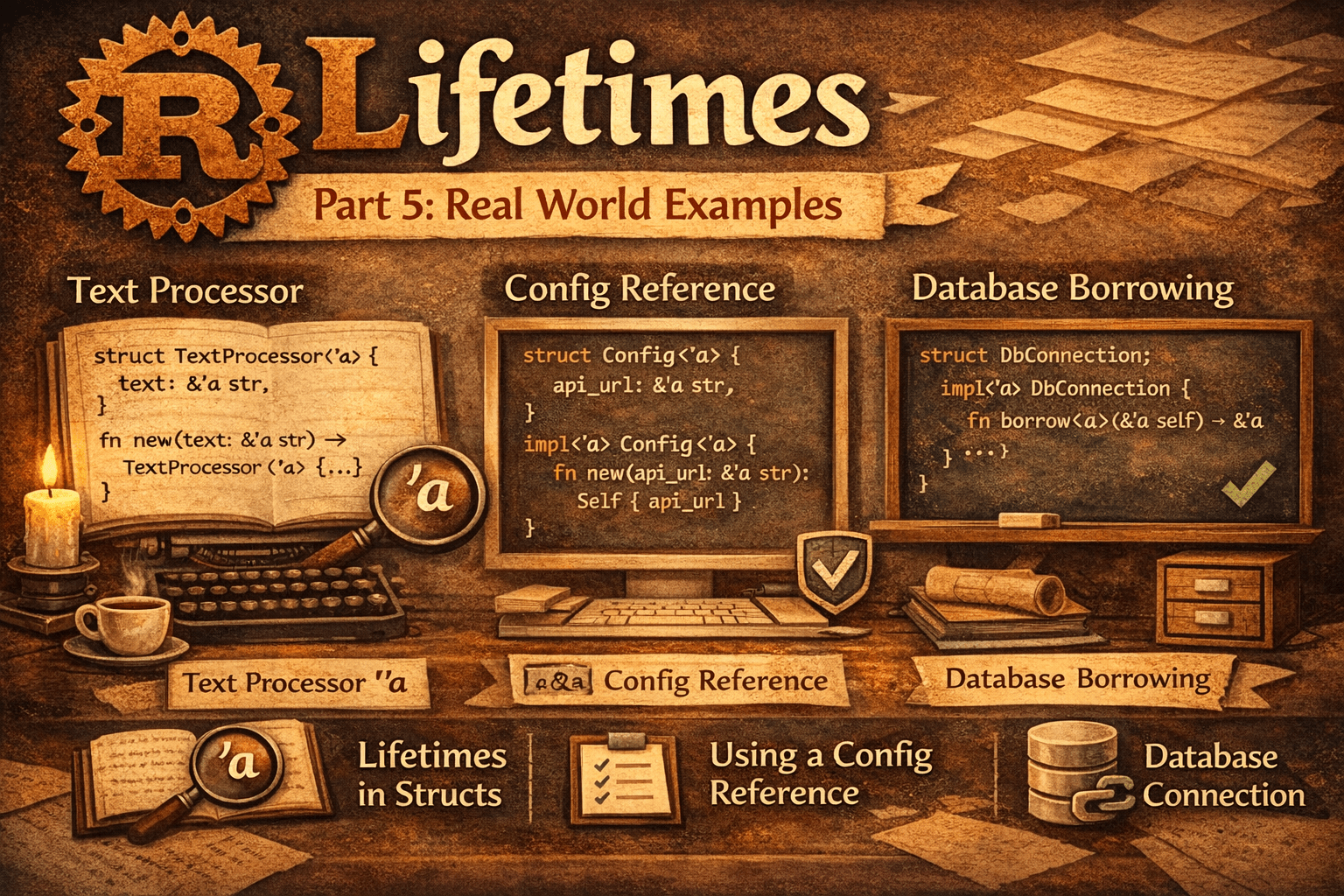

We’ve reached the finale of our in-depth journey through Rust lifetimes! In the previous parts, we built from basics to advanced concepts: introductions and syntax in Part 1, applications in functions and data structures in Part 2, simplifications via elision and ‘static in Part 3, and sophisticated integrations with generics, traits, bounds, plus error troubleshooting in Part 4.
In this concluding Part 5, we’ll bring it all together with Real-World Examples and Best Practices to show lifetimes in action across practical scenarios. Then, we’ll wrap up with a Conclusion and Further Resources to solidify your learning and point you toward next steps. These sections include code examples drawn from common Rust use cases, tips for idiomatic code, and recommendations to deepen your expertise.
Thank you for following along—let’s make lifetimes second nature!
Real-World Examples and Best Practices
Theory is great, but seeing lifetimes solve real problems cements understanding. Here, we’ll explore examples from libraries, performance-critical code, and everyday Rust patterns. We’ll also distill best practices to avoid common pitfalls and write maintainable code.
Example 1: Parsing Without Copying (Zero-Copy Parsing)
Lifetimes enable efficient borrowing in parsers, avoiding unnecessary allocations. Consider a CSV parser that returns views into the input string.
use std::str::Split;
struct CsvRow<'a> {
    fields: Split<'a, char>,
}
impl<'a> CsvRow<'a> {
    fn new(line: &'a str) -> Self {
        CsvRow {
            fields: line.split(','),
        }
    }
    fn next_field(&mut self) -> Option<&'a str> {
        self.fields.next()
    }
}
fn parse_csv<'a>(input: &'a str) -> Vec<CsvRow<'a>> {
    input.lines().map(CsvRow::new).collect()
}
fn main() {
    let data = "name,age,city\nAlice,30,New York\nBob,25,San Francisco";
    let rows = parse_csv(data);
    for mut row in rows {
        while let Some(field) = row.next_field() {
            print!("{} ", field.trim());
        }
        println!();
    }
}
Here, CsvRow<‘a> borrows from input, enabling zero-copy access. The ‘a ensures rows don’t outlive the data. Best practice: Use lifetimes for views into large data to minimize memory use, common in web servers or data processing.
Example 2: Thread-Safe Sharing with ‘static
In concurrent code, ‘static ensures data outlives threads.
use std::thread;
fn main() {
    let config: &'static str = "Shared config";
    let handle = thread::spawn(move || {
        println!("In thread: {}", config);
    });
    handle.join().unwrap();
    println!("Main: {}", config);  // Still accessible
}
Best practice: For globals in threads, prefer ‘static or Arc for shared ownership. Avoid leaking unless necessary—use scopes or channels instead.
Example 3: Generic API with Lifetime Bounds in Traits
Building a trait for extractors:
trait Extractor<'a> {
    type Output: 'a;
    fn extract(&self, input: &'a str) -> Self::Output;
}
struct UrlExtractor;
impl<'a> Extractor<'a> for UrlExtractor {
    type Output = &'a str;
    fn extract(&self, input: &'a str) -> &'a str {
        // Simplified: return input if it starts with http
        if input.starts_with("http") {
            input
        } else {
            ""
        }
    }
}
fn process_extractor<'a, E: Extractor<'a>>(extractor: E, data: &'a str) -> E::Output {
    extractor.extract(data)
}
fn main() {
    let text = "Visit http://example.com";
    let url = process_extractor(UrlExtractor, text);
    println!("Extracted: {}", url);
}
The associated type Output: ‘a bounds it to the input lifetime. Best practice: In traits, use lifetimes to make APIs flexible yet safe, as in crates like nom for parsing or reqwest for HTTP.
Example 4: Self-Referential Structs (Advanced)
For structures that reference themselves, use crates like ouroboros or pin-project. Simple example with manual pinning:
use std::pin::Pin;
struct SelfRef<'a> {
    data: String,
    ref_to_data: Option<&'a str>,
}
impl<'a> SelfRef<'a> {
    fn new(data: String) -> Self {
        Self { data, ref_to_data: None }
    }
    fn init_ref(self: Pin<&mut Self>) {
        let this = unsafe { self.get_unchecked_mut() };
        this.ref_to_data = Some(&this.data);
    }
}
fn main() {
    let mut sr = SelfRef::new("Hello".to_string());
    let mut pinned = unsafe { Pin::new_unchecked(&mut sr) };
    pinned.as_mut().init_ref();
    if let Some(r) = pinned.ref_to_data {
        println!("{}", r);
    }
}
Best practice: Avoid self-referential unless essential (e.g., async futures). Use Pin carefully—it’s unsafe but enables advanced patterns.
Best Practices Summary
- Start Simple: Use elision first; add explicit lifetimes only when needed.
- Minimize Lifetimes: Fewer parameters mean simpler code. Share lifetimes where possible.
- Document Relationships: In public APIs, explicit annotations clarify contracts.
- Test Edge Cases: Check with different scopes, threads, and generics.
- Leverage Tools: Use rust-analyzer for lifetime visualizations; Clippy for lints like lifetime-underdetermined.
- Performance Mindset: Lifetimes reduce cloning—profile with cargo flamegraph.
- Learning Path: Practice with exercises from “The Rust Book” or contribute to open-source crates.
- Common Anti-Pattern: Don’t force ‘static everywhere; it limits flexibility. Prefer bounded lifetimes.
Applying these will make your Rust code safer, faster, and more elegant.
Conclusion and Further Resources
Rust lifetimes are a cornerstone of its memory safety, transforming potential runtime errors into compile-time checks. While they have a learning curve, they empower you to write concurrent, efficient code without fear of dangling pointers or data races. From basic function annotations to advanced trait bounds, lifetimes unlock Rust’s full potential for systems programming, web assembly, and beyond.
As you experiment, remember: the borrow checker is rigorous but fair. Embrace errors as teachers, and soon you’ll intuitively design with lifetimes in mind.
Further Resources
- Official Docs: “The Rust Programming Language” book, Chapter 10 on generics, traits, and lifetimes (rust-lang.org/book).
- In-Depth Guides: “Rustonomicon” for unsafe aspects; “Rust by Example” for interactive snippets.
- Communities: Rust subreddit (reddit.com/r/rust), Discord, or forums for questions.
- Crates to Study: serde for serialization, tokio for async, rayon for parallelism—see how they handle lifetimes.
- Tools: Rust Playground (play.rust-lang.org) for quick tests; Cargo expand for macro insights.
- Books: “Rust for Rustaceans” by Jon Gjengset for advanced topics.
- Videos: Jon Gjengset’s streams on YouTube, or “Crust of Rust” series.