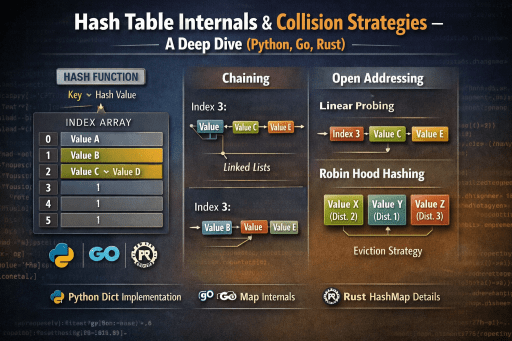
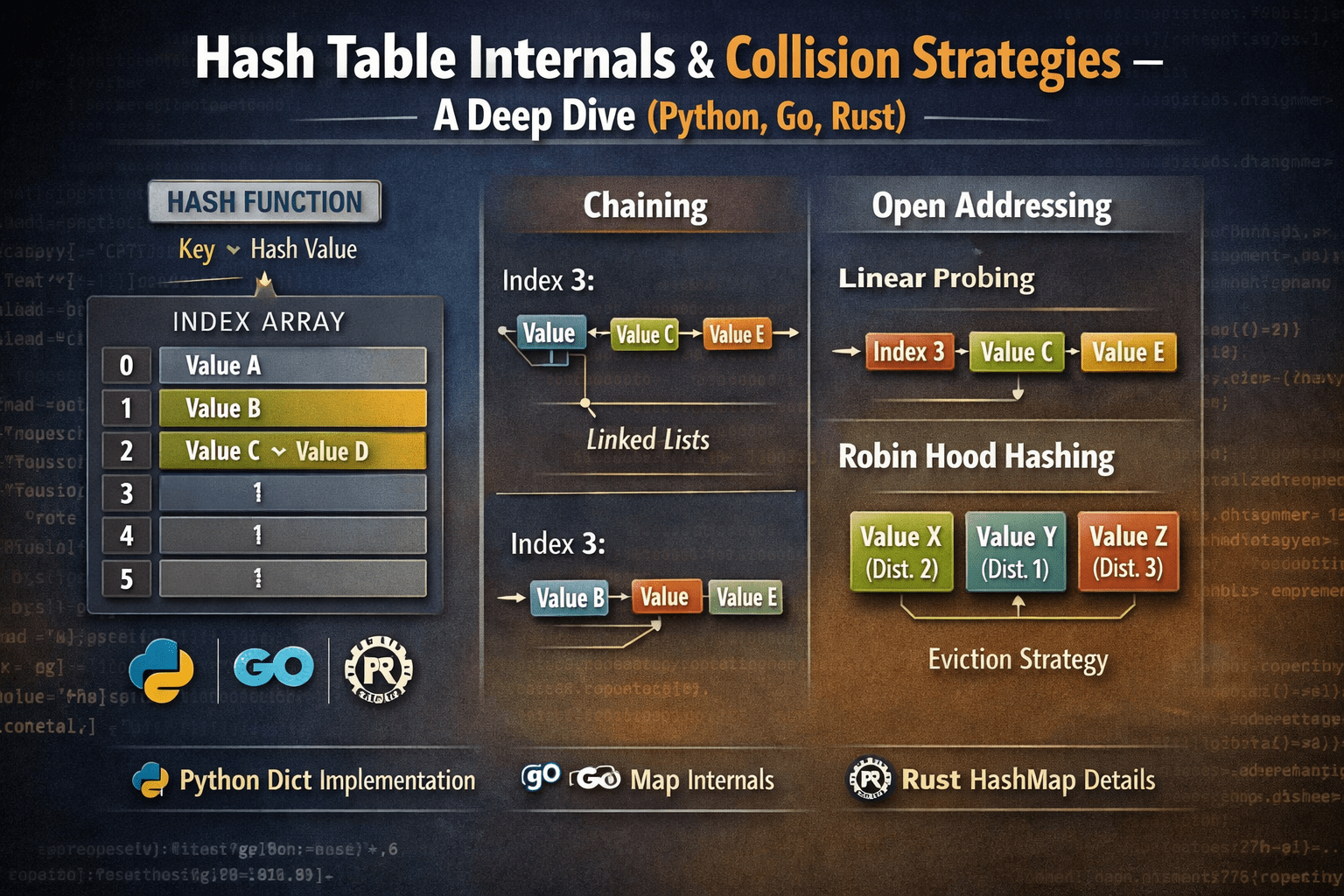

Hash tables stand as one of the most fundamental and widely used data structures in all of computer science. At their core, they solve a deceptively simple problem: how do you store and retrieve data by key in constant time? The answer involves a fascinating interplay of mathematical hashing, memory layout design, and collision resolution — a domain where theoretical elegance meets real-world engineering constraints like CPU cache hierarchies, SIMD instruction sets, and denial-of-service attack resilience.
The principle behind a hash table is straightforward. A deterministic hash function transforms a key into an integer, which is then mapped to an index in a fixed-size array. This allows insertions, lookups, and deletions to operate in amortized O(1) time — a performance guarantee that underpins everything from database indexing and compiler symbol tables to in-memory caches and network routing tables. However, this simplicity conceals a critical challenge: collisions. Since the space of possible keys is virtually infinite while the backing array is finite, multiple keys will inevitably map to the same slot. How a hash table handles these collisions defines its character, its performance profile, and its suitability for different workloads.
This research provides a comprehensive deep dive into the internal mechanics of hash tables and the major collision resolution strategies that have evolved over decades of research and engineering. We begin with separate chaining, the classical approach where each bucket holds a linked list of colliding entries — simple to implement but hostile to modern CPU caches. We then move into the family of open addressing techniques, where all entries reside directly within the array. Linear probing offers excellent cache locality but suffers from primary clustering. Quadratic probing mitigates clustering at the cost of requiring careful table sizing. Double hashing eliminates both primary and secondary clustering by using a second hash function to determine probe step sizes.
Beyond these textbook strategies, we explore two more sophisticated modern approaches. Robin Hood hashing introduces a beautifully simple invariant — during insertion, entries with longer probe distances “steal” slots from entries with shorter ones, dramatically equalizing lookup times and enabling early termination during searches. Cuckoo hashing takes a radically different approach, guaranteeing worst-case O(1) lookups by maintaining two hash functions and evicting existing entries to alternate locations on collision, at the cost of more complex insertion logic.
The research goes further by examining how three major programming languages implement hash tables in practice. Python‘s dict uses a compact open-addressing scheme with perturbed probing that preserves insertion order. Go’s map employs a unique hybrid of chaining with 8-entry buckets and top-hash bytes for fast rejection. Rust‘s HashMap, built on Google’s SwissTable design, represents the state of the art — using SIMD instructions to probe 16 slots simultaneously through carefully designed control byte metadata, achieving remarkable performance at load factors as high as 87.5%.
Each strategy is accompanied by complete, working implementations in Python, Go, and Rust, demonstrating not just the algorithms but the practical considerations of memory layout, resizing policies, and deletion mechanics. Through both theoretical analysis and real-world engineering perspective, this research reveals how a data structure born from a simple idea has evolved into one of the most carefully optimized components in modern software systems.
Table of Contents
- Foundational Concepts
- Hash Functions Internals
- Collision Strategy #1 — Separate Chaining
- Collision Strategy #2 — Open Addressing (Linear Probing)
- Collision Strategy #3 — Quadratic Probing
- Collision Strategy #4 — Double Hashing
- Collision Strategy #5 — Robin Hood Hashing
- Collision Strategy #6 — Cuckoo Hashing
- Load Factor, Resizing & Amortized Analysis
- How Real Languages Do It (CPython, Go, Rust)
- Performance Comparison Summary
1. Foundational Concepts
A hash table is a data structure that maps keys → values in amortized O(1) time by using a hash function to compute an index into an array of buckets/slots.
Key ──▶ hash(key) ──▶ index = hash % capacity ──▶ bucket[index]
Core Components
| Component | Description |
|---|---|
| Backing Array | Contiguous memory block of fixed size (capacity) |
| Hash Function | Deterministic function mapping keys to integers |
| Index Mapping | hash(key) % capacity → slot index |
| Collision Strategy | What happens when two keys map to the same slot |
| Load Factor | α = n / capacity (n = number of stored entries) |
| Resize Policy | When and how the table grows/shrinks |
Why Collisions Are Inevitable — The Pigeonhole Principle
If your key space is larger than your table capacity (and it almost always is), multiple keys must map to the same slot. Even with a perfect hash function, by the birthday paradox, collisions appear surprisingly early — with a table of size m, there’s a >50% chance of collision after only ~√m insertions.
2. Hash Functions
Before diving into collision strategies, understanding the hash function is critical.
Properties of a Good Hash Function
- Deterministic: Same key always produces the same hash
- Uniform Distribution: Outputs are spread evenly across the output range
- Avalanche Effect: A small change in input drastically changes output
- Fast to compute: O(1) for fixed-size keys
Common Hash Functions Used in Practice
| Hash Function | Used By | Type |
|---|---|---|
| SipHash 1-3 / 2-4 | Rust HashMap, Python 3.4+ | Keyed (DoS-resistant) |
| AES-based hash | Go runtime | Hardware-accelerated |
| FNV-1a | Common general-purpose | Simple, fast |
| xxHash | Data processing | Very fast, non-crypto |
| MurmurHash3 | Many distributed systems | Fast, good distribution |
| Wyhash | Many modern systems | Extremely fast |
Simple Hash Function Example (FNV-1a style)
Python (FNV-1a inspired hash)
def fnv1a_hash(key: bytes) -> int:
    FNV_OFFSET = 2166136261
    FNV_PRIME = 16777619
    h = FNV_OFFSET
    for byte in key:
        h ^= byte
        h = (h * FNV_PRIME) & 0xFFFFFFFF  # keep 32-bit
    return h
print(fnv1a_hash(b"hello"))   # 1335831723
print(fnv1a_hash(b"hellp"))   # completely different
Go (FNV-1a)
package main
import (
	"fmt"
	"hash/fnv"
)
func fnv1aHash(key string) uint32 {
	h := fnv.New32a()
	h.Write([]byte(key))
	return h.Sum32()
}
func main() {
	fmt.Println(fnv1aHash("hello")) // 1335831723
	fmt.Println(fnv1aHash("hellp")) // 1553940770 (Completely different)
}
Rust — manual FNV-1a
fn fnv1a_hash(key: &[u8]) -> u32 {
    const FNV_OFFSET: u32 = 2166136261;
    const FNV_PRIME: u32 = 16777619;
    let mut hash = FNV_OFFSET;
    for &byte in key {
        hash ^= byte as u32;
        hash = hash.wrapping_mul(FNV_PRIME);
    }
    hash
}
fn main() {
    println!("{}", fnv1a_hash(b"hello"));  // 1335831723
    println!("{}", fnv1a_hash(b"hellp"));  // 1553940770 (Completely different)
}
3. Collision Strategy #1 — Separate Chaining
Concept
Each bucket holds a linked list (or other collection) of all entries that hash to that index. On collision, the new entry is simply appended to the chain.
textIndex 0: ──▶ (k1,v1) ──▶ (k4,v4) ──▶ nil
Index 1: ──▶ nil
Index 2: ──▶ (k2,v2) ──▶ nil
Index 3: ──▶ (k3,v3) ──▶ (k5,v5) ──▶ (k7,v7) ──▶ nil
Index 4: ──▶ nil
Characteristics
| Property | Value |
|---|---|
| Load factor α | Can exceed 1.0 |
| Worst case lookup | O(n) — all keys in one chain |
| Average lookup | O(1 + α) |
| Cache friendliness | Poor — pointer chasing |
| Memory overhead | High — node pointers per entry |
| Deletion | Simple — just unlink |
Python Implementation
class Node:
    """A node in the chain (singly linked list)."""
    __slots__ = ('key', 'value', 'next')
    def __init__(self, key, value, next_node=None):
        self.key = key
        self.value = value
        self.next = next_node
class ChainingHashTable:
    """Hash table using separate chaining for collision resolution."""
    def __init__(self, initial_capacity=8, max_load_factor=0.75):
        self._capacity = initial_capacity
        self._size = 0
        self._max_load_factor = max_load_factor
        self._buckets: list[Node | None] = [None] * self._capacity
    # --- Core hash & index ---
    def _hash(self, key) -> int:
        """Use Python's built-in hash, then map to index."""
        return hash(key)
    def _index(self, key) -> int:
        return self._hash(key) % self._capacity
    # --- Load factor ---
    @property
    def load_factor(self) -> float:
        return self._size / self._capacity
    # --- INSERT ---
    def put(self, key, value):
        if self.load_factor >= self._max_load_factor:
            self._resize(self._capacity * 2)
        idx = self._index(key)
        node = self._buckets[idx]
        # Walk the chain — update if key exists
        while node is not None:
            if node.key == key:
                node.value = value  # update
                return
            node = node.next
        # Prepend new node (O(1))
        new_node = Node(key, value, self._buckets[idx])
        self._buckets[idx] = new_node
        self._size += 1
    # --- GET ---
    def get(self, key, default=None):
        idx = self._index(key)
        node = self._buckets[idx]
        while node is not None:
            if node.key == key:
                return node.value
            node = node.next
        return default
    # --- DELETE ---
    def delete(self, key) -> bool:
        idx = self._index(key)
        node = self._buckets[idx]
        prev = None
        while node is not None:
            if node.key == key:
                if prev is None:
                    self._buckets[idx] = node.next
                else:
                    prev.next = node.next
                self._size -= 1
                return True
            prev = node
            node = node.next
        return False
    # --- RESIZE ---
    def _resize(self, new_capacity: int):
        old_buckets = self._buckets
        self._capacity = new_capacity
        self._buckets = [None] * new_capacity
        self._size = 0
        for head in old_buckets:
            node = head
            while node is not None:
                self.put(node.key, node.value)
                node = node.next
    # --- Utility ---
    def __len__(self):
        return self._size
    def __contains__(self, key):
        return self.get(key, _sentinel := object()) is not _sentinel
    def __repr__(self):
        items = []
        for head in self._buckets:
            node = head
            while node:
                items.append(f"{node.key!r}: {node.value!r}")
                node = node.next
        return "{" + ", ".join(items) + "}"
    def debug_structure(self):
        """Visualize the internal bucket structure."""
        for i, head in enumerate(self._buckets):
            chain = []
            node = head
            while node:
                chain.append(f"({node.key!r},{node.value!r})")
                node = node.next
            chain_str = " -> ".join(chain) if chain else "empty"
            print(f"  Bucket[{i}]: {chain_str}")
# --- Demo ---
if __name__ == "__main__":
    ht = ChainingHashTable(initial_capacity=4)
    for word in ["apple", "banana", "cherry", "date", "elderberry", "fig"]:
        ht.put(word, len(word))
    print(f"Size: {len(ht)}, Load Factor: {ht.load_factor:.2f}")
    ht.debug_structure()
    print(f"\nget('cherry') = {ht.get('cherry')}")
    ht.delete("banana")
    print(f"After deleting 'banana': 'banana' in ht = {'banana' in ht}")
Go Implementation
package main
import "fmt"
// ---------- Separate Chaining Hash Table ----------
type entry struct {
	key   string
	value interface{}
	next  *entry
}
type ChainingHashTable struct {
	buckets       []*entry
	capacity      int
	size          int
	maxLoadFactor float64
}
func NewChainingHashTable(capacity int) *ChainingHashTable {
	return &ChainingHashTable{
		buckets:       make([]*entry, capacity),
		capacity:      capacity,
		maxLoadFactor: 0.75,
	}
}
// Simple FNV-1a hash
func (ht *ChainingHashTable) hash(key string) int {
	var h uint32 = 2166136261
	for i := 0; i < len(key); i++ {
		h ^= uint32(key[i])
		h *= 16777619
	}
	return int(h)
}
func (ht *ChainingHashTable) index(key string) int {
	return ht.hash(key) % ht.capacity
}
func (ht *ChainingHashTable) loadFactor() float64 {
	return float64(ht.size) / float64(ht.capacity)
}
// Put inserts or updates a key-value pair
func (ht *ChainingHashTable) Put(key string, value interface{}) {
	if ht.loadFactor() >= ht.maxLoadFactor {
		ht.resize(ht.capacity * 2)
	}
	idx := ht.index(key)
	node := ht.buckets[idx]
	for node != nil {
		if node.key == key {
			node.value = value // update
			return
		}
		node = node.next
	}
	// Prepend
	newEntry := &entry{key: key, value: value, next: ht.buckets[idx]}
	ht.buckets[idx] = newEntry
	ht.size++
}
// Get retrieves a value by key
func (ht *ChainingHashTable) Get(key string) (interface{}, bool) {
	idx := ht.index(key)
	node := ht.buckets[idx]
	for node != nil {
		if node.key == key {
			return node.value, true
		}
		node = node.next
	}
	return nil, false
}
// Delete removes a key
func (ht *ChainingHashTable) Delete(key string) bool {
	idx := ht.index(key)
	node := ht.buckets[idx]
	var prev *entry
	for node != nil {
		if node.key == key {
			if prev == nil {
				ht.buckets[idx] = node.next
			} else {
				prev.next = node.next
			}
			ht.size--
			return true
		}
		prev = node
		node = node.next
	}
	return false
}
func (ht *ChainingHashTable) resize(newCapacity int) {
	oldBuckets := ht.buckets
	ht.buckets = make([]*entry, newCapacity)
	ht.capacity = newCapacity
	ht.size = 0
	for _, head := range oldBuckets {
		node := head
		for node != nil {
			ht.Put(node.key, node.value)
			node = node.next
		}
	}
}
func (ht *ChainingHashTable) DebugPrint() {
	for i, head := range ht.buckets {
		chain := ""
		node := head
		for node != nil {
			if chain != "" {
				chain += " -> "
			}
			chain += fmt.Sprintf("(%s,%v)", node.key, node.value)
			node = node.next
		}
		if chain == "" {
			chain = "empty"
		}
		fmt.Printf("  Bucket[%d]: %s\n", i, chain)
	}
}
func main() {
	ht := NewChainingHashTable(4)
	words := []string{"apple", "banana", "cherry", "date", "elderberry"}
	for _, w := range words {
		ht.Put(w, len(w))
	}
	fmt.Printf("Size: %d, Load Factor: %.2f\n", ht.size, ht.loadFactor())
	ht.DebugPrint()
	if val, ok := ht.Get("cherry"); ok {
		fmt.Printf("\nGet('cherry') = %v\n", val)
	}
}
Rust Implementation
use std::collections::hash_map::DefaultHasher;
use std::hash::{Hash, Hasher};
// ---------- Separate Chaining Hash Table ----------
struct Entry<K, V> {
    key: K,
    value: V,
}
pub struct ChainingHashTable<K, V> {
    buckets: Vec<Vec<Entry<K, V>>>,  // Vec of Vecs instead of linked lists
    capacity: usize,
    size: usize,
    max_load_factor: f64,
}
impl<K: Hash + Eq + Clone + std::fmt::Debug, V: Clone + std::fmt::Debug>
    ChainingHashTable<K, V>
{
    pub fn new(capacity: usize) -> Self {
        let mut buckets = Vec::with_capacity(capacity);
        for _ in 0..capacity {
            buckets.push(Vec::new());
        }
        Self {
            buckets,
            capacity,
            size: 0,
            max_load_factor: 0.75,
        }
    }
    fn hash_index(&self, key: &K) -> usize {
        let mut hasher = DefaultHasher::new();
        key.hash(&mut hasher);
        (hasher.finish() as usize) % self.capacity
    }
    pub fn load_factor(&self) -> f64 {
        self.size as f64 / self.capacity as f64
    }
    pub fn put(&mut self, key: K, value: V) {
        if self.load_factor() >= self.max_load_factor {
            self.resize(self.capacity * 2);
        }
        let idx = self.hash_index(&key);
        // Update if exists
        for entry in &mut self.buckets[idx] {
            if entry.key == key {
                entry.value = value;
                return;
            }
        }
        // Push new entry
        self.buckets[idx].push(Entry { key, value });
        self.size += 1;
    }
    pub fn get(&self, key: &K) -> Option<&V> {
        let idx = self.hash_index(key);
        for entry in &self.buckets[idx] {
            if entry.key == *key {
                return Some(&entry.value);
            }
        }
        None
    }
    pub fn delete(&mut self, key: &K) -> bool {
        let idx = self.hash_index(key);
        if let Some(pos) = self.buckets[idx].iter().position(|e| e.key == *key) {
            self.buckets[idx].swap_remove(pos);
            self.size -= 1;
            return true;
        }
        false
    }
    fn resize(&mut self, new_capacity: usize) {
        let old_buckets = std::mem::replace(
            &mut self.buckets,
            (0..new_capacity).map(|_| Vec::new()).collect(),
        );
        self.capacity = new_capacity;
        self.size = 0;
        for bucket in old_buckets {
            for entry in bucket {
                self.put(entry.key, entry.value);
            }
        }
    }
    pub fn debug_print(&self) {
        for (i, bucket) in self.buckets.iter().enumerate() {
            if bucket.is_empty() {
                println!("  Bucket[{}]: empty", i);
            } else {
                let entries: Vec<String> = bucket
                    .iter()
                    .map(|e| format!("({:?},{:?})", e.key, e.value))
                    .collect();
                println!("  Bucket[{}]: {}", i, entries.join(" -> "));
            }
        }
    }
}
fn main() {
    let mut ht = ChainingHashTable::new(4);
    for word in &["apple", "banana", "cherry", "date", "elderberry"] {
        ht.put(word.to_string(), word.len());
    }
    println!("Size: {}, Load Factor: {:.2}", ht.size, ht.load_factor());
    ht.debug_print();
    if let Some(val) = ht.get(&"cherry".to_string()) {
        println!("\nget(\"cherry\") = {}", val);
    }
}
4. Collision Strategy #2 — Open Addressing: Linear Probing
Concept
All entries live directly inside the array. On collision, we probe the next slot sequentially:
textprobe(key, i) = (hash(key) + i) % capacity for i = 0, 1, 2, 3, ...textInsert "cat" → hash = 3
Insert "dog" → hash = 3 (collision!)
→ try slot 4... empty! Place here.
Insert "rat" → hash = 3 (collision!)
→ try slot 4... occupied! try slot 5... empty! Place here.
Index: 0 1 2 [3] [4] [5] 6 7
nil nil nil cat dog rat nil nilThe Clustering Problem
Linear probing suffers from primary clustering: consecutive occupied slots form long runs, and the probability of a slot extending a cluster is proportional to the cluster’s length. This creates a feedback loop.
textPerformance degrades as clusters grow:
α = 0.5  →  avg probes ≈ 1.5
α = 0.7  →  avg probes ≈ 2.17
α = 0.9  →  avg probes ≈ 5.5
α = 0.99 →  avg probes ≈ 50.5
Deletion: Tombstones vs. Backward Shift
Two approaches:
- Tombstones (DELETED markers): Mark slot as deleted, don’t break probe chains. Simple but pollutes the table.
- Backward-shift deletion: Shift subsequent entries backward to fill the gap. More complex but keeps the table clean.
Python Implementation (with Backward-Shift Delete)
from enum import Enum
from typing import Any
class SlotState(Enum):
    EMPTY = 0
    OCCUPIED = 1
class LinearProbingHashTable:
    """Hash table with linear probing and backward-shift deletion."""
    def __init__(self, initial_capacity=8, max_load_factor=0.6):
        self._capacity = initial_capacity
        self._size = 0
        self._max_load = max_load_factor
        # Parallel arrays for cache-friendliness
        self._keys = [None] * self._capacity
        self._values = [None] * self._capacity
        self._states = [SlotState.EMPTY] * self._capacity
    def _hash(self, key) -> int:
        return hash(key)
    def _index(self, key) -> int:
        return self._hash(key) % self._capacity
    @property
    def load_factor(self) -> float:
        return self._size / self._capacity
    # --- INSERT ---
    def put(self, key, value):
        if self.load_factor >= self._max_load:
            self._resize(self._capacity * 2)
        idx = self._index(key)
        while True:
            state = self._states[idx]
            if state == SlotState.EMPTY:
                # Place here
                self._keys[idx] = key
                self._values[idx] = value
                self._states[idx] = SlotState.OCCUPIED
                self._size += 1
                return
            elif self._keys[idx] == key:
                # Update existing
                self._values[idx] = value
                return
            # Linear probe: next slot
            idx = (idx + 1) % self._capacity
    # --- GET ---
    def get(self, key, default=None):
        idx = self._index(key)
        while True:
            state = self._states[idx]
            if state == SlotState.EMPTY:
                return default
            if self._keys[idx] == key:
                return self._values[idx]
            idx = (idx + 1) % self._capacity
    # --- DELETE (backward-shift) ---
    def delete(self, key) -> bool:
        idx = self._index(key)
        # Find the key
        while True:
            if self._states[idx] == SlotState.EMPTY:
                return False  # not found
            if self._keys[idx] == key:
                break
            idx = (idx + 1) % self._capacity
        # Found at idx — now backward-shift
        while True:
            next_idx = (idx + 1) % self._capacity
            # If next slot is empty or the key at next_idx is at its natural
            # position (i.e., it wasn't displaced), we can stop
            if (self._states[next_idx] == SlotState.EMPTY or
                    self._index(self._keys[next_idx]) == next_idx):
                # Clear current slot
                self._keys[idx] = None
                self._values[idx] = None
                self._states[idx] = SlotState.EMPTY
                self._size -= 1
                return True
            # Check if the entry at next_idx was displaced past idx
            # i.e., its natural position is at or before idx in the probe chain
            natural = self._index(self._keys[next_idx])
            # Determine if natural position is "before or at" idx
            # considering wrapping
            if self._is_between(natural, idx, next_idx):
                # This entry belongs in a position ≤ idx, so shift it back
                self._keys[idx] = self._keys[next_idx]
                self._values[idx] = self._values[next_idx]
                idx = next_idx
            else:
                # Clear current and stop
                self._keys[idx] = None
                self._values[idx] = None
                self._states[idx] = SlotState.EMPTY
                self._size -= 1
                return True
    def _is_between(self, natural, gap, current):
        """Check if natural position is in the range (gap, current] circularly,
        meaning the entry at current was displaced past gap."""
        if gap < current:
            return not (gap < natural <= current)
        else:  # wraps around
            return natural <= gap and natural > current
    # --- RESIZE ---
    def _resize(self, new_capacity):
        old_keys = self._keys
        old_values = self._values
        old_states = self._states
        self._capacity = new_capacity
        self._keys = [None] * new_capacity
        self._values = [None] * new_capacity
        self._states = [SlotState.EMPTY] * new_capacity
        self._size = 0
        for i in range(len(old_keys)):
            if old_states[i] == SlotState.OCCUPIED:
                self.put(old_keys[i], old_values[i])
    # --- Utility ---
    def __len__(self):
        return self._size
    def __contains__(self, key):
        sentinel = object()
        return self.get(key, sentinel) is not sentinel
    def debug_print(self):
        for i in range(self._capacity):
            state = self._states[i]
            if state == SlotState.OCCUPIED:
                natural = self._index(self._keys[i])
                displacement = (i - natural) % self._capacity
                print(f"  [{i}] {self._keys[i]!r} => {self._values[i]!r}  "
                      f"(natural={natural}, displaced={displacement})")
            else:
                print(f"  [{i}] ---")
# --- Demo ---
if __name__ == "__main__":
    ht = LinearProbingHashTable(initial_capacity=16)
    words = ["apple", "banana", "cherry", "date", "elderberry",
             "fig", "grape", "honeydew"]
    for w in words:
        ht.put(w, len(w))
    print(f"Size: {len(ht)}, Load: {ht.load_factor:.2f}")
    ht.debug_print()
    print(f"\nget('fig') = {ht.get('fig')}")
    ht.delete("cherry")
    print("\nAfter deleting 'cherry':")
    ht.debug_print()
Golang Implementation (with Backward-Shift Delete)
package main
import "fmt"
const (
	stateEmpty    = 0
	stateOccupied = 1
)
type LinearProbingHT struct {
	keys     []string
	values   []int
	states   []int
	capacity int
	size     int
	maxLoad  float64
}
func NewLinearProbingHT(capacity int) *LinearProbingHT {
	return &LinearProbingHT{
		keys:     make([]string, capacity),
		values:   make([]int, capacity),
		states:   make([]int, capacity),
		capacity: capacity,
		maxLoad:  0.6,
	}
}
func (ht *LinearProbingHT) hash(key string) int {
	var h uint32 = 2166136261
	for i := 0; i < len(key); i++ {
		h ^= uint32(key[i])
		h *= 16777619
	}
	return int(h)
}
func (ht *LinearProbingHT) index(key string) int {
	h := ht.hash(key)
	idx := h % ht.capacity
	if idx < 0 {
		idx += ht.capacity
	}
	return idx
}
func (ht *LinearProbingHT) loadFactor() float64 {
	return float64(ht.size) / float64(ht.capacity)
}
func (ht *LinearProbingHT) Put(key string, value int) {
	if ht.loadFactor() >= ht.maxLoad {
		ht.resize(ht.capacity * 2)
	}
	idx := ht.index(key)
	for {
		if ht.states[idx] == stateEmpty {
			ht.keys[idx] = key
			ht.values[idx] = value
			ht.states[idx] = stateOccupied
			ht.size++
			return
		}
		if ht.keys[idx] == key {
			ht.values[idx] = value
			return
		}
		idx = (idx + 1) % ht.capacity
	}
}
func (ht *LinearProbingHT) Get(key string) (int, bool) {
	idx := ht.index(key)
	for {
		if ht.states[idx] == stateEmpty {
			return 0, false
		}
		if ht.keys[idx] == key {
			return ht.values[idx], true
		}
		idx = (idx + 1) % ht.capacity
	}
}
// Delete with backward shift
func (ht *LinearProbingHT) Delete(key string) bool {
	idx := ht.index(key)
	// Find key
	for {
		if ht.states[idx] == stateEmpty {
			return false
		}
		if ht.keys[idx] == key {
			break
		}
		idx = (idx + 1) % ht.capacity
	}
	// Backward-shift loop
	for {
		next := (idx + 1) % ht.capacity
		if ht.states[next] == stateEmpty {
			break
		}
		natural := ht.index(ht.keys[next])
		// Check if next entry was displaced past idx
		if ht.shouldShift(natural, idx, next) {
			ht.keys[idx] = ht.keys[next]
			ht.values[idx] = ht.values[next]
			idx = next
		} else {
			break
		}
	}
	ht.keys[idx] = ""
	ht.values[idx] = 0
	ht.states[idx] = stateEmpty
	ht.size--
	return true
}
func (ht *LinearProbingHT) shouldShift(natural, gap, current int) bool {
	if gap < current {
		return natural <= gap || natural > current
	}
	return natural <= gap && natural > current
}
func (ht *LinearProbingHT) resize(newCap int) {
	oldKeys := ht.keys
	oldValues := ht.values
	oldStates := ht.states
	ht.keys = make([]string, newCap)
	ht.values = make([]int, newCap)
	ht.states = make([]int, newCap)
	ht.capacity = newCap
	ht.size = 0
	for i, state := range oldStates {
		if state == stateOccupied {
			ht.Put(oldKeys[i], oldValues[i])
		}
	}
}
func (ht *LinearProbingHT) DebugPrint() {
	for i := 0; i < ht.capacity; i++ {
		if ht.states[i] == stateOccupied {
			natural := ht.index(ht.keys[i])
			disp := (i - natural + ht.capacity) % ht.capacity
			fmt.Printf("  [%d] %s => %d (natural=%d, disp=%d)\n",
				i, ht.keys[i], ht.values[i], natural, disp)
		} else {
			fmt.Printf("  [%d] ---\n", i)
		}
	}
}
func main() {
	ht := NewLinearProbingHT(16)
	words := []string{"apple", "banana", "cherry", "date", "elderberry", "fig"}
	for _, w := range words {
		ht.Put(w, len(w))
	}
	fmt.Printf("Size: %d, Load: %.2f\n", ht.size, ht.loadFactor())
	ht.DebugPrint()
	if val, ok := ht.Get("fig"); ok {
		fmt.Printf("\nGet(\"fig\") = %d\n", val)
	}
}
Rust Implementation (with Backward-Shift Delete)
use std::collections::hash_map::DefaultHasher;
use std::hash::{Hash, Hasher};
#[derive(Clone, Copy, PartialEq)]
enum SlotState {
    Empty,
    Occupied,
}
pub struct LinearProbingHashTable<K, V> {
    keys: Vec<Option<K>>,
    values: Vec<Option<V>>,
    states: Vec<SlotState>,
    capacity: usize,
    size: usize,
    max_load: f64,
}
impl<K: Hash + Eq + Clone + std::fmt::Debug, V: Clone + std::fmt::Debug>
LinearProbingHashTable<K, V>
{
    pub fn new(capacity: usize) -> Self {
        Self {
            keys: vec![None; capacity],
            values: vec![None; capacity],
            states: vec![SlotState::Empty; capacity],
            capacity,
            size: 0,
            max_load: 0.6,
        }
    }
    fn hash_index(&self, key: &K) -> usize {
        let mut hasher = DefaultHasher::new();
        key.hash(&mut hasher);
        (hasher.finish() as usize) % self.capacity
    }
    pub fn load_factor(&self) -> f64 {
        self.size as f64 / self.capacity as f64
    }
    pub fn put(&mut self, key: K, value: V) {
        if self.load_factor() >= self.max_load {
            self.resize(self.capacity * 2);
        }
        let mut idx = self.hash_index(&key);
        loop {
            match self.states[idx] {
                SlotState::Empty => {
                    self.keys[idx] = Some(key);
                    self.values[idx] = Some(value);
                    self.states[idx] = SlotState::Occupied;
                    self.size += 1;
                    return;
                }
                SlotState::Occupied => {
                    if self.keys[idx].as_ref() == Some(&key) {
                        self.values[idx] = Some(value);
                        return;
                    }
                }
            }
            idx = (idx + 1) % self.capacity;
        }
    }
    pub fn get(&self, key: &K) -> Option<&V> {
        let mut idx = self.hash_index(key);
        loop {
            match self.states[idx] {
                SlotState::Empty => return None,
                SlotState::Occupied => {
                    if self.keys[idx].as_ref() == Some(key) {
                        return self.values[idx].as_ref();
                    }
                }
            }
            idx = (idx + 1) % self.capacity;
        }
    }
    pub fn delete(&mut self, key: &K) -> bool {
        let mut idx = self.hash_index(key);
        // Find the key
        loop {
            if self.states[idx] == SlotState::Empty {
                return false;
            }
            if self.keys[idx].as_ref() == Some(key) {
                break;
            }
            idx = (idx + 1) % self.capacity;
        }
        // Backward-shift
        loop {
            let next = (idx + 1) % self.capacity;
            if self.states[next] == SlotState::Empty {
                break;
            }
            let natural = self.hash_index(self.keys[next].as_ref().unwrap());
            if self.should_shift(natural, idx, next) {
                self.keys[idx] = self.keys[next].clone();
                self.values[idx] = self.values[next].clone();
                idx = next;
            } else {
                break;
            }
        }
        self.keys[idx] = None;
        self.values[idx] = None;
        self.states[idx] = SlotState::Empty;
        self.size -= 1;
        true
    }
    fn should_shift(&self, natural: usize, gap: usize, current: usize) -> bool {
        if gap < current {
            natural <= gap || natural > current
        } else {
            natural <= gap && natural > current
        }
    }
    fn resize(&mut self, new_capacity: usize) {
        let old_keys = std::mem::replace(&mut self.keys, vec![None; new_capacity]);
        let old_values = std::mem::replace(&mut self.values, vec![None; new_capacity]);
        let old_states =
            std::mem::replace(&mut self.states, vec![SlotState::Empty; new_capacity]);
        self.capacity = new_capacity;
        self.size = 0;
        for i in 0..old_keys.len() {
            if old_states[i] == SlotState::Occupied {
                if let (Some(k), Some(v)) = (old_keys[i].clone(), old_values[i].clone()) {
                    self.put(k, v);
                }
            }
        }
    }
    pub fn debug_print(&self) {
        for i in 0..self.capacity {
            match self.states[i] {
                SlotState::Occupied => {
                    let k = self.keys[i].as_ref().unwrap();
                    let v = self.values[i].as_ref().unwrap();
                    let natural = self.hash_index(k);
                    let disp = (i + self.capacity - natural) % self.capacity;
                    println!("  [{}] {:?} => {:?}  (natural={}, disp={})",
                             i, k, v, natural, disp);
                }
                SlotState::Empty => {
                    println!("  [{}] ---", i);
                }
            }
        }
    }
}
fn main() {
    let mut ht = LinearProbingHashTable::new(16);
    for word in &["apple", "banana", "cherry", "date", "elderberry", "fig"] {
        ht.put(word.to_string(), word.len());
    }
    println!("Size: {}, Load: {:.2}", ht.size, ht.load_factor());
    ht.debug_print();
    if let Some(val) = ht.get(&"fig".to_string()) {
        println!("\nget(\"fig\") = {}", val);
    }
}
5. Collision Strategy #3 — Quadratic Probing
Concept
Instead of probing linearly (+1, +2, +3, ...), quadratic probing uses a quadratic function:
textprobe(key, i) = (hash(key) + c1*i + c2*i²) % capacityCommon choices: c1 = 0, c2 = 1 → probing sequence: +0, +1, +4, +9, +16, ...
Or: c1 = 1/2, c2 = 1/2 → +0, +1, +3, +6, +10, ... (triangular numbers)
Key Insight: Table Size Matters
Theorem: If the table size is prime and the load factor ≤ 0.5, quadratic probing with h(k) + i² is guaranteed to find an empty slot and visits distinct slots for i = 0, 1, ..., (m-1)/2.
With power-of-two sizes, use triangular numbers: h(k) + i*(i+1)/2 — guaranteed to probe all slots.
Eliminates Primary Clustering, But…
Quadratic probing eliminates primary clustering but still suffers from secondary clustering: keys that hash to the same initial index follow the same probe sequence.
Python Implementation
class QuadraticProbingHashTable:
    """
    Quadratic probing with triangular numbers: probe(i) = i*(i+1)//2
    Works with power-of-two table sizes.
    """
    EMPTY = object()
    DELETED = object()  # tombstone approach for simplicity
    def __init__(self, initial_capacity=8, max_load=0.5):
        # Ensure power of two
        self._capacity = initial_capacity
        self._max_load = max_load
        self._size = 0
        self._keys = [self.EMPTY] * self._capacity
        self._values = [None] * self._capacity
    def _index(self, key) -> int:
        return hash(key) % self._capacity
    @property
    def load_factor(self):
        return self._size / self._capacity
    def put(self, key, value):
        if self.load_factor >= self._max_load:
            self._resize(self._capacity * 2)
        idx = self._index(key)
        first_deleted = -1
        i = 0
        while True:
            probe_idx = (idx + i * (i + 1) // 2) % self._capacity
            if self._keys[probe_idx] is self.EMPTY:
                target = first_deleted if first_deleted != -1 else probe_idx
                self._keys[target] = key
                self._values[target] = value
                self._size += 1
                return
            elif self._keys[probe_idx] is self.DELETED:
                if first_deleted == -1:
                    first_deleted = probe_idx
            elif self._keys[probe_idx] == key:
                self._values[probe_idx] = value
                return
            i += 1
    def get(self, key, default=None):
        idx = self._index(key)
        i = 0
        while True:
            probe_idx = (idx + i * (i + 1) // 2) % self._capacity
            if self._keys[probe_idx] is self.EMPTY:
                return default
            if self._keys[probe_idx] == key:
                return self._values[probe_idx]
            i += 1
    def delete(self, key) -> bool:
        idx = self._index(key)
        i = 0
        while True:
            probe_idx = (idx + i * (i + 1) // 2) % self._capacity
            if self._keys[probe_idx] is self.EMPTY:
                return False
            if self._keys[probe_idx] == key:
                self._keys[probe_idx] = self.DELETED
                self._values[probe_idx] = None
                self._size -= 1
                return True
            i += 1
    def _resize(self, new_cap):
        old_keys = self._keys
        old_vals = self._values
        self._capacity = new_cap
        self._keys = [self.EMPTY] * new_cap
        self._values = [None] * new_cap
        self._size = 0
        for i, k in enumerate(old_keys):
            if k is not self.EMPTY and k is not self.DELETED:
                self.put(k, old_vals[i])
    def debug_print(self):
        for i in range(self._capacity):
            k = self._keys[i]
            if k is self.EMPTY:
                print(f"  [{i}] ---")
            elif k is self.DELETED:
                print(f"  [{i}] TOMBSTONE")
            else:
                print(f"  [{i}] {k!r} => {self._values[i]!r}")
if __name__ == "__main__":
    ht = QuadraticProbingHashTable(initial_capacity=16)
    for w in ["alpha", "bravo", "charlie", "delta", "echo", "foxtrot"]:
        ht.put(w, w.upper())
    print(f"Size: {ht._size}, Load: {ht.load_factor:.2f}")
    ht.debug_print()
    print(f"\nget('echo') = {ht.get('echo')}")
6. Collision Strategy #4 — Double Hashing
Concept
Uses a second hash function to determine the probe step size, eliminating both primary and secondary clustering:
textprobe(key, i) = (h1(key) + i * h2(key)) % capacityConstraint: h2(key) must never return 0 (otherwise we’d loop in place) and should be coprime with the table capacity. Common approach: make capacity prime, and use h2(key) = PRIME - (hash(key) % PRIME) where PRIME < capacity.
Python Implementation
class DoubleHashingTable:
    """Hash table with double hashing for collision resolution."""
    EMPTY = object()
    DELETED = object()
    def __init__(self, capacity=13, max_load=0.6):
        # Capacity should be prime for best results
        self._capacity = capacity
        self._max_load = max_load
        self._size = 0
        self._keys = [self.EMPTY] * capacity
        self._values = [None] * capacity
        # Second prime, smaller than capacity
        self._prime2 = self._smaller_prime(capacity)
    @staticmethod
    def _smaller_prime(n):
        """Find largest prime smaller than n."""
        for candidate in range(n - 1, 1, -1):
            if all(candidate % i != 0 for i in range(2, int(candidate**0.5) + 1)):
                return candidate
        return 1
    def _h1(self, key) -> int:
        return hash(key) % self._capacity
    def _h2(self, key) -> int:
        """Second hash — guaranteed non-zero and coprime with capacity."""
        return self._prime2 - (hash(key) % self._prime2)
    def _probe(self, key, i) -> int:
        return (self._h1(key) + i * self._h2(key)) % self._capacity
    @property
    def load_factor(self):
        return self._size / self._capacity
    def put(self, key, value):
        if self.load_factor >= self._max_load:
            self._resize()
        first_deleted = -1
        for i in range(self._capacity):
            idx = self._probe(key, i)
            if self._keys[idx] is self.EMPTY:
                target = first_deleted if first_deleted != -1 else idx
                self._keys[target] = key
                self._values[target] = value
                self._size += 1
                return
            elif self._keys[idx] is self.DELETED:
                if first_deleted == -1:
                    first_deleted = idx
            elif self._keys[idx] == key:
                self._values[idx] = value
                return
        # Table is full (shouldn't happen with proper load management)
        raise RuntimeError("Hash table is full")
    def get(self, key, default=None):
        for i in range(self._capacity):
            idx = self._probe(key, i)
            if self._keys[idx] is self.EMPTY:
                return default
            if self._keys[idx] == key:
                return self._values[idx]
        return default
    def delete(self, key) -> bool:
        for i in range(self._capacity):
            idx = self._probe(key, i)
            if self._keys[idx] is self.EMPTY:
                return False
            if self._keys[idx] == key:
                self._keys[idx] = self.DELETED
                self._values[idx] = None
                self._size -= 1
                return True
        return False
    @staticmethod
    def _next_prime(n):
        """Find next prime >= n."""
        candidate = n
        while True:
            if candidate < 2:
                candidate = 2
            if all(candidate % i != 0 for i in range(2, int(candidate**0.5) + 1)):
                return candidate
            candidate += 1
    def _resize(self):
        new_cap = self._next_prime(self._capacity * 2)
        old_keys, old_vals = self._keys, self._values
        self._capacity = new_cap
        self._prime2 = self._smaller_prime(new_cap)
        self._keys = [self.EMPTY] * new_cap
        self._values = [None] * new_cap
        self._size = 0
        for i, k in enumerate(old_keys):
            if k is not self.EMPTY and k is not self.DELETED:
                self.put(k, old_vals[i])
    def debug_print(self):
        for i in range(self._capacity):
            k = self._keys[i]
            if k is self.EMPTY:
                print(f"  [{i:2d}] ---")
            elif k is self.DELETED:
                print(f"  [{i:2d}] TOMBSTONE")
            else:
                print(f"  [{i:2d}] {k!r} => {self._values[i]!r} "
                      f"(h1={self._h1(k)}, h2={self._h2(k)})")
if __name__ == "__main__":
    ht = DoubleHashingTable(capacity=13)
    for w in ["sun", "moon", "star", "planet", "comet", "nebula", "galaxy"]:
        ht.put(w, w.upper())
    print(f"Size: {ht._size}, Cap: {ht._capacity}, Load: {ht.load_factor:.2f}")
    print(f"Prime2: {ht._prime2}")
    ht.debug_print()
    print(f"\nget('comet') = {ht.get('comet')}")
7. Collision Strategy #5 — Robin Hood Hashing
Concept
A variant of linear probing that equalizes probe distances. The key insight: during insertion, if the entry being inserted has traveled further from its home than the entry currently occupying a slot, they swap — the “rich” (short displacement) entry gives up its slot to the “poor” (long displacement) entry.
textRobin Hood Rule:
  If displacement(new_entry) > displacement(existing_entry):
      swap them, continue inserting the displaced entry
Why It’s Brilliant
- Dramatically reduces variance in probe lengths
- Expected maximum probe length: O(log n) instead of O(n)
- Lookups can terminate early: if you’ve probed further than the displacement of the current slot, the key doesn’t exist
- Great cache behavior (like all linear probing variants)
Visual Example
textInserting entries with their "displacement" (distance from home):

Before Robin Hood:
  [0] A (disp=0)    [1] B (disp=0)    [2] C (disp=2)    [3] D (disp=3)

Some entries are displaced a lot, others not at all.

After Robin Hood rebalancing:
  [0] A (disp=0)    [1] X (disp=1)    [2] B (disp=1)    [3] C (disp=1)

DisplaIcements are much more uniform!
Python Implementation
class RobinHoodHashTable:
    """Robin Hood hashing: steal from the rich, give to the poor."""
    def __init__(self, initial_capacity=8, max_load=0.7):
        self._capacity = initial_capacity
        self._max_load = max_load
        self._size = 0
        self._keys = [None] * self._capacity
        self._values = [None] * self._capacity
        self._occupied = [False] * self._capacity
    def _hash(self, key) -> int:
        return hash(key) % self._capacity
    def _displacement(self, key, current_idx) -> int:
        """How far this key is from its home slot."""
        home = self._hash(key)
        return (current_idx - home + self._capacity) % self._capacity
    @property
    def load_factor(self):
        return self._size / self._capacity
    def put(self, key, value):
        if self.load_factor >= self._max_load:
            self._resize(self._capacity * 2)
        idx = self._hash(key)
        incoming_key = key
        incoming_value = value
        incoming_disp = 0
        while True:
            if not self._occupied[idx]:
                # Empty slot — place here
                self._keys[idx] = incoming_key
                self._values[idx] = incoming_value
                self._occupied[idx] = True
                self._size += 1
                return
            if self._keys[idx] == incoming_key:
                # Update existing
                self._values[idx] = incoming_value
                return
            # Compare displacements
            existing_disp = self._displacement(self._keys[idx], idx)
            if incoming_disp > existing_disp:
                # ROBIN HOOD: steal from the rich!
                # Swap incoming with existing
                self._keys[idx], incoming_key = incoming_key, self._keys[idx]
                self._values[idx], incoming_value = incoming_value, self._values[idx]
                incoming_disp = existing_disp
            # Continue probing
            idx = (idx + 1) % self._capacity
            incoming_disp += 1
    def get(self, key, default=None):
        idx = self._hash(key)
        disp = 0
        while True:
            if not self._occupied[idx]:
                return default
            if self._keys[idx] == key:
                return self._values[idx]
            # EARLY TERMINATION: if our probe distance exceeds
            # the displacement of the entry at this slot,
            # then our key cannot exist further along
            existing_disp = self._displacement(self._keys[idx], idx)
            if disp > existing_disp:
                return default  # key definitely not in table
            idx = (idx + 1) % self._capacity
            disp += 1
    def delete(self, key) -> bool:
        idx = self._hash(key)
        disp = 0
        # Find the key
        while True:
            if not self._occupied[idx]:
                return False
            if self._keys[idx] == key:
                break
            existing_disp = self._displacement(self._keys[idx], idx)
            if disp > existing_disp:
                return False
            idx = (idx + 1) % self._capacity
            disp += 1
        # Backward-shift deletion
        while True:
            next_idx = (idx + 1) % self._capacity
            if not self._occupied[next_idx]:
                break
            next_disp = self._displacement(self._keys[next_idx], next_idx)
            if next_disp == 0:
                break  # next entry is at its home; can't shift
            # Shift backward
            self._keys[idx] = self._keys[next_idx]
            self._values[idx] = self._values[next_idx]
            idx = next_idx
        # Clear the final slot
        self._keys[idx] = None
        self._values[idx] = None
        self._occupied[idx] = False
        self._size -= 1
        return True
    def _resize(self, new_cap):
        old_keys = self._keys
        old_values = self._values
        old_occupied = self._occupied
        self._capacity = new_cap
        self._keys = [None] * new_cap
        self._values = [None] * new_cap
        self._occupied = [False] * new_cap
        self._size = 0
        for i in range(len(old_keys)):
            if old_occupied[i]:
                self.put(old_keys[i], old_values[i])
    def __len__(self):
        return self._size
    def stats(self):
        """Show displacement statistics — the hallmark of Robin Hood."""
        displacements = []
        for i in range(self._capacity):
            if self._occupied[i]:
                d = self._displacement(self._keys[i], i)
                displacements.append(d)
        if not displacements:
            print("  Table is empty")
            return
        print(f"  Entries: {len(displacements)}")
        print(f"  Max displacement: {max(displacements)}")
        print(f"  Avg displacement: {sum(displacements)/len(displacements):.2f}")
        print(f"  Displacement distribution: ", end="")
        from collections import Counter
        dist = Counter(displacements)
        for d in sorted(dist.keys()):
            print(f"d={d}:{dist[d]} ", end="")
        print()
    def debug_print(self):
        for i in range(self._capacity):
            if self._occupied[i]:
                d = self._displacement(self._keys[i], i)
                home = self._hash(self._keys[i])
                print(f"  [{i:2d}] {self._keys[i]!r:>15} => {self._values[i]!r:<10} "
                      f"home={home:2d}  disp={d}")
            else:
                print(f"  [{i:2d}] ---")
if __name__ == "__main__":
    ht = RobinHoodHashTable(initial_capacity=16, max_load=0.7)
    words = ["alpha", "bravo", "charlie", "delta", "echo",
             "foxtrot", "golf", "hotel", "india", "juliet"]
    for w in words:
        ht.put(w, len(w))
    print(f"Size: {len(ht)}, Load: {ht.load_factor:.2f}\n")
    ht.debug_print()
    print("\nDisplacement statistics:")
    ht.stats()
    print(f"\nget('hotel') = {ht.get('hotel')}")
Golang Implementation:
package main
import "fmt"
type RobinHoodHT struct {
	keys     []string
	values   []int
	occupied []bool
	capacity int
	size     int
	maxLoad  float64
}
func NewRobinHoodHT(capacity int) *RobinHoodHT {
	return &RobinHoodHT{
		keys:     make([]string, capacity),
		values:   make([]int, capacity),
		occupied: make([]bool, capacity),
		capacity: capacity,
		maxLoad:  0.7,
	}
}
func (ht *RobinHoodHT) hash(key string) int {
	var h uint32 = 2166136261
	for i := 0; i < len(key); i++ {
		h ^= uint32(key[i])
		h *= 16777619
	}
	return int(h % uint32(ht.capacity))
}
func (ht *RobinHoodHT) displacement(key string, idx int) int {
	home := ht.hash(key)
	return (idx - home + ht.capacity) % ht.capacity
}
func (ht *RobinHoodHT) loadFactor() float64 {
	return float64(ht.size) / float64(ht.capacity)
}
func (ht *RobinHoodHT) Put(key string, value int) {
	if ht.loadFactor() >= ht.maxLoad {
		ht.resize(ht.capacity * 2)
	}
	idx := ht.hash(key)
	inKey, inVal := key, value
	inDisp := 0
	for {
		if !ht.occupied[idx] {
			ht.keys[idx] = inKey
			ht.values[idx] = inVal
			ht.occupied[idx] = true
			ht.size++
			return
		}
		if ht.keys[idx] == inKey {
			ht.values[idx] = inVal
			return
		}
		existDisp := ht.displacement(ht.keys[idx], idx)
		if inDisp > existDisp {
			// Robin Hood swap!
			ht.keys[idx], inKey = inKey, ht.keys[idx]
			ht.values[idx], inVal = inVal, ht.values[idx]
			inDisp = existDisp
		}
		idx = (idx + 1) % ht.capacity
		inDisp++
	}
}
func (ht *RobinHoodHT) Get(key string) (int, bool) {
	idx := ht.hash(key)
	disp := 0
	for {
		if !ht.occupied[idx] {
			return 0, false
		}
		if ht.keys[idx] == key {
			return ht.values[idx], true
		}
		existDisp := ht.displacement(ht.keys[idx], idx)
		if disp > existDisp {
			return 0, false // early termination
		}
		idx = (idx + 1) % ht.capacity
		disp++
	}
}
func (ht *RobinHoodHT) resize(newCap int) {
	oldKeys := ht.keys
	oldVals := ht.values
	oldOcc := ht.occupied
	ht.keys = make([]string, newCap)
	ht.values = make([]int, newCap)
	ht.occupied = make([]bool, newCap)
	ht.capacity = newCap
	ht.size = 0
	for i, occ := range oldOcc {
		if occ {
			ht.Put(oldKeys[i], oldVals[i])
		}
	}
}
func (ht *RobinHoodHT) Stats() {
	maxDisp := 0
	totalDisp := 0
	for i := 0; i < ht.capacity; i++ {
		if ht.occupied[i] {
			d := ht.displacement(ht.keys[i], i)
			totalDisp += d
			if d > maxDisp {
				maxDisp = d
			}
		}
	}
	if ht.size > 0 {
		fmt.Printf("  Max displacement: %d, Avg: %.2f\n",
			maxDisp, float64(totalDisp)/float64(ht.size))
	}
}
func main() {
	ht := NewRobinHoodHT(16)
	words := []string{"alpha", "bravo", "charlie", "delta",
		"echo", "foxtrot", "golf", "hotel", "india", "juliet"}
	for _, w := range words {
		ht.Put(w, len(w))
	}
	fmt.Printf("Size: %d, Load: %.2f\n", ht.size, ht.loadFactor())
	ht.Stats()
	if val, ok := ht.Get("hotel"); ok {
		fmt.Printf("Get(\"hotel\") = %d\n", val)
	}
}
8. Collision Strategy #6 — Cuckoo Hashing
Concept
Uses two (or more) hash functions, each mapping to a different table (or region). Each key has exactly two possible locations. On collision, the existing entry is evicted (“cuckooed”) to its alternate location, potentially triggering a chain of evictions.
textTable1:  h1(key) → position in table 1
Table2:  h2(key) → position in table 2
Insert key:
  1. Try table1[h1(key)] — if empty, place there
  2. Try table2[h2(key)] — if empty, place there
  3. Evict whoever is at table1[h1(key)], place new key there
  4. Place evicted key at its alternate location
  5. If that causes another eviction, continue...
  6. If cycle detected or max iterations reached → resize & rehash
Key Properties
| Property | Value |
|---|---|
| Lookup | O(1) worst case (only 2 locations to check!) |
| Insert | O(1) amortized (can trigger chains) |
| Max load factor | ~50% (with 2 tables), ~91% (with 3+ functions) |
| Space overhead | Higher (needs lower load factor) |
Python Implementation:
import random
class CuckooHashTable:
    """Cuckoo hashing with two hash functions and two tables."""
    MAX_EVICTIONS = 500  # cycle detection threshold
    def __init__(self, capacity=8):
        self._capacity = capacity
        self._size = 0
        # Two tables
        self._keys1 = [None] * capacity
        self._vals1 = [None] * capacity
        self._keys2 = [None] * capacity
        self._vals2 = [None] * capacity
        # Random seeds for hash functions
        self._seed1 = random.randint(0, 2**32)
        self._seed2 = random.randint(0, 2**32)
    def _h1(self, key) -> int:
        return (hash(key) ^ self._seed1) % self._capacity
    def _h2(self, key) -> int:
        return (hash(key) ^ self._seed2) % self._capacity
    @property
    def load_factor(self):
        return self._size / (2 * self._capacity)
    # --- LOOKUP: O(1) worst case! ---
    def get(self, key, default=None):
        idx1 = self._h1(key)
        if self._keys1[idx1] == key:
            return self._vals1[idx1]
        idx2 = self._h2(key)
        if self._keys2[idx2] == key:
            return self._vals2[idx2]
        return default
    # --- INSERT ---
    def put(self, key, value):
        # Check if already exists — update
        idx1 = self._h1(key)
        if self._keys1[idx1] == key:
            self._vals1[idx1] = value
            return
        idx2 = self._h2(key)
        if self._keys2[idx2] == key:
            self._vals2[idx2] = value
            return
        # Insert with possible eviction chain
        self._cuckoo_insert(key, value)
    def _cuckoo_insert(self, key, value):
        cur_key, cur_val = key, value
        for _ in range(self.MAX_EVICTIONS):
            # Try table 1
            idx1 = self._h1(cur_key)
            if self._keys1[idx1] is None:
                self._keys1[idx1] = cur_key
                self._vals1[idx1] = cur_val
                self._size += 1
                return
            # Evict from table 1
            self._keys1[idx1], cur_key = cur_key, self._keys1[idx1]
            self._vals1[idx1], cur_val = cur_val, self._vals1[idx1]
            # Try table 2 with evicted key
            idx2 = self._h2(cur_key)
            if self._keys2[idx2] is None:
                self._keys2[idx2] = cur_key
                self._vals2[idx2] = cur_val
                self._size += 1
                return
            # Evict from table 2
            self._keys2[idx2], cur_key = cur_key, self._keys2[idx2]
            self._vals2[idx2], cur_val = cur_val, self._vals2[idx2]
        # Cycle detected — rehash with new seeds and larger table
        self._rehash()
        self.put(cur_key, cur_val)
    # --- DELETE: O(1) worst case ---
    def delete(self, key) -> bool:
        idx1 = self._h1(key)
        if self._keys1[idx1] == key:
            self._keys1[idx1] = None
            self._vals1[idx1] = None
            self._size -= 1
            return True
        idx2 = self._h2(key)
        if self._keys2[idx2] == key:
            self._keys2[idx2] = None
            self._vals2[idx2] = None
            self._size -= 1
            return True
        return False
    def _rehash(self):
        old_keys1, old_vals1 = self._keys1, self._vals1
        old_keys2, old_vals2 = self._keys2, self._vals2
        self._capacity *= 2
        self._keys1 = [None] * self._capacity
        self._vals1 = [None] * self._capacity
        self._keys2 = [None] * self._capacity
        self._vals2 = [None] * self._capacity
        self._size = 0
        # New hash seeds
        self._seed1 = random.randint(0, 2**32)
        self._seed2 = random.randint(0, 2**32)
        for i in range(len(old_keys1)):
            if old_keys1[i] is not None:
                self.put(old_keys1[i], old_vals1[i])
        for i in range(len(old_keys2)):
            if old_keys2[i] is not None:
                self.put(old_keys2[i], old_vals2[i])
    def __len__(self):
        return self._size
    def __contains__(self, key):
        return self.get(key, _s := object()) is not _s
    def debug_print(self):
        print("  Table 1:")
        for i in range(self._capacity):
            if self._keys1[i] is not None:
                print(f"    [{i}] {self._keys1[i]!r} => {self._vals1[i]!r}")
            else:
                print(f"    [{i}] ---")
        print("  Table 2:")
        for i in range(self._capacity):
            if self._keys2[i] is not None:
                print(f"    [{i}] {self._keys2[i]!r} => {self._vals2[i]!r}")
            else:
                print(f"    [{i}] ---")
if __name__ == "__main__":
    ht = CuckooHashTable(capacity=8)
    words = ["red", "blue", "green", "yellow", "purple",
             "orange", "pink", "black", "white", "gray"]
    for w in words:
        ht.put(w, w.upper())
    print(f"Size: {len(ht)}, Load: {ht.load_factor:.2f}")
    print(f"Capacity per table: {ht._capacity}\n")
    # O(1) worst-case lookup — only checks 2 slots!
    for w in ["green", "pink", "cyan"]:
        result = ht.get(w, "NOT FOUND")
        print(f"  get({w!r}) = {result}")
    ht.debug_print()
9. Load Factor, Resizing & Amortized Analysis
Load Factor Thresholds by Strategy
| Strategy | Typical Max α | Why |
|---|---|---|
| Separate Chaining | 0.75 – 1.0 | Chains grow linearly; α > 1 is fine |
| Linear Probing | 0.5 – 0.7 | Clustering degrades rapidly past 0.7 |
| Quadratic Probing | 0.5 | Must stay ≤ 0.5 for guaranteed slot finding |
| Double Hashing | 0.6 – 0.7 | Better than linear, less clustering |
| Robin Hood | 0.7 – 0.9 | Equalized displacements handle high load |
| Cuckoo (2 funcs) | 0.5 | Per-table; ~0.5 total capacity utilization |
Resize Strategy: Amortized O(1)
When the load factor exceeds the threshold:
- Allocate a new array of 2× capacity
- Rehash every existing entry (O(n) operation)
- Because this only happens after n/2 insertions, the amortized cost per insertion is O(1)
textInsertions:  1  2  3  4  5  6  7  8  9  10  11  12  13  14  15  16  17
                         ↑                              ↑
                      resize(8→16)                  resize(16→32)
                      cost: 8                       cost: 16
Total cost for 17 inserts: 17 + 8 + 16 = 41  →  41/17 ≈ 2.4 = O(1) amortized
Growth Factor Analysis
| Growth Factor | Space Waste | Resize Frequency | Used By |
|---|---|---|---|
| 2× | Up to 50% unused | Less frequent | Most implementations |
| 1.5× | Up to 33% unused | More frequent | Facebook folly |
| φ (≈1.618) | Good balance | Moderate | Some C++ libs |
10. How Real Languages Do It
CPython dict (Python 3.6+)
Python’s dictionary is one of the most heavily optimized hash tables in existence.
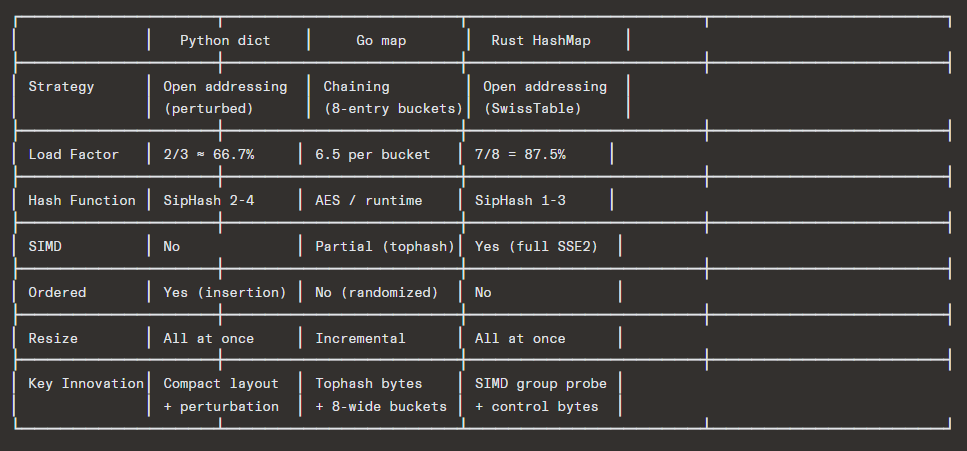
Strategy: Open addressing with perturbed probing (a custom probe sequence)
C Code:
// CPython's probe sequence (simplified from dictobject.c)
// j = initial index
// perturb = full hash value
while (1) {
    if (slot_is_empty_or_matches)
        return slot;
    perturb >>= PERTURB_SHIFT;  // PERTURB_SHIFT = 5
    j = (5 * j + perturb + 1) % capacity;
}
Key design decisions:
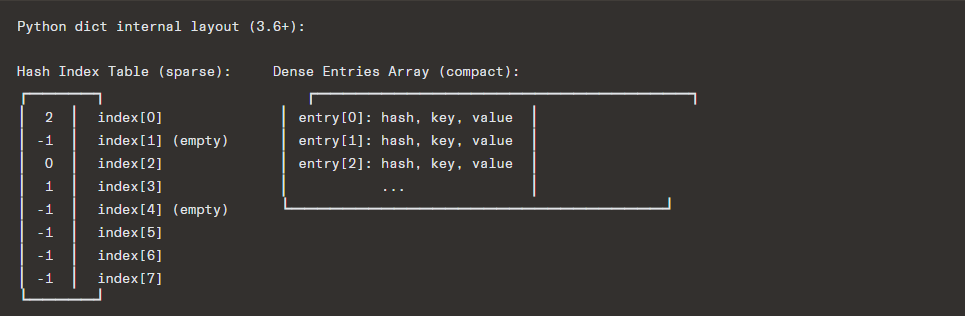
- Compact dict (since 3.6): Separates a hash index table (sparse, small entries) from a dense entries array (ordered). This gives insertion-ordered iteration and saves ~25% memory.
- Table capacity is always a power of 2
- Load factor threshold: 2/3 ≈ 0.667
- Uses SipHash for strings (DoS protection)
- Growth: 2× when small, capacity based on used + growth estimate
Go map
Strategy: Separate chaining with buckets (a highly optimized hybrid)
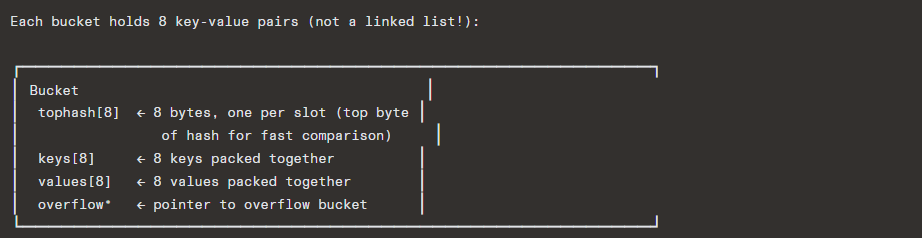
Go’s map uses a unique approach:
Key design decisions:
- Bucket size = 8 entries (fits cache line well)
- Top-hash byte stored per entry: fast rejection without comparing full keys
- Load factor threshold: 6.5 entries per bucket (α ≈ 6.5)
- Incremental resizing: doesn’t rehash everything at once; gradually evacuates old buckets during subsequent operations
- Map capacity always power of 2 number of buckets
- Iteration order is intentionally randomized (starting bucket is random)
textLookup process:
1. hash(key) → lower bits select bucket, top 8 bits = tophash
2. Compare tophash[i] for each of 8 slots (SIMD-friendly!)
3. Only if tophash matches, compare full key
4. If not found, follow overflow pointer
Rust HashMap (hashbrown / SwissTable)
Strategy: Open addressing with SIMD-accelerated probing (Swiss Table design from Google)
This is the most modern and sophisticated design of the three.
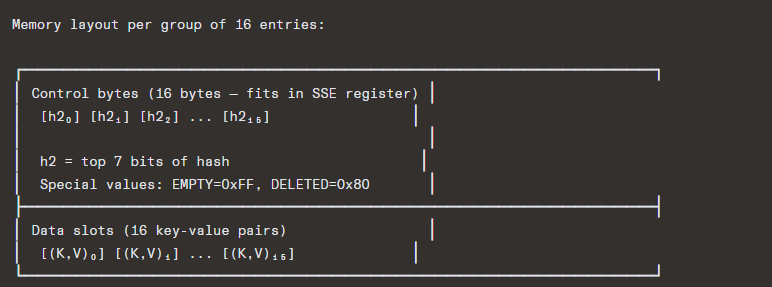
Key design decisions:
- Groups of 16 slots with 16 control bytes (one byte per slot)
- Control bytes hold the top 7 bits of the hash (h2) or a sentinel
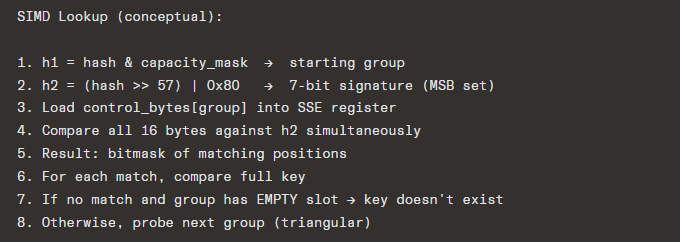
- Probing uses SIMD: load all 16 control bytes into a 128-bit register, compare against h2 with a single instruction, get a bitmask of matching slots
- This means checking 16 slots simultaneously in 1 CPU instruction!
- Uses SipHash 1-3 by default (DoS resistant, but configurable)
- Load factor: grows at 7/8 = 87.5% (can afford high load due to SIMD)
- Triangular probing over groups: group sequence = 0, 1, 3, 6, 10, … (triangular numbers)
Summary Comparison
11. Performance Comparison
Theoretical Average-Case Probe Counts
For a table with load factor α:
| Strategy | Successful Search | Unsuccessful Search |
|---|---|---|
| Separate Chaining | 1 + α/2 | 1 + α |
| Linear Probing | ½(1 + 1/(1-α)) | ½(1 + (1/(1-α))²) |
| Quadratic Probing | -ln(1-α)/α | 1/(1-α) – α + ln(1-α) |
| Double Hashing | -ln(1-α)/α | 1/(1-α) |
| Robin Hood | Same as linear avg | O(log n) worst case |
At α = 0.7
| Strategy | Avg Probes (Hit) | Avg Probes (Miss) |
|---|---|---|
| Chaining | 1.35 | 1.70 |
| Linear Probing | 1.72 | 6.06 |
| Double Hashing | 1.53 | 3.33 |
| Robin Hood | 1.72 (avg) | max ≈ O(log n) |
Cache Behavior
This is often the dominant factor in real-world performance:
textSeparate Chaining:
  ❌ Pointer chasing → random memory access → cache misses
  ❌ Nodes scattered across heap
Linear/Quadratic/Robin Hood Probing:
  ✅ Sequential memory access → prefetcher friendly
  ✅ All data in contiguous array
SwissTable:
  ✅✅ Control bytes are tiny (16 bytes per group, fits in cache line)
  ✅✅ SIMD operates on register-width data
  ✅✅ Only touches data slots on actual match
Final Takeaway
The evolution of hash tables tells a story of trading complexity for performance:
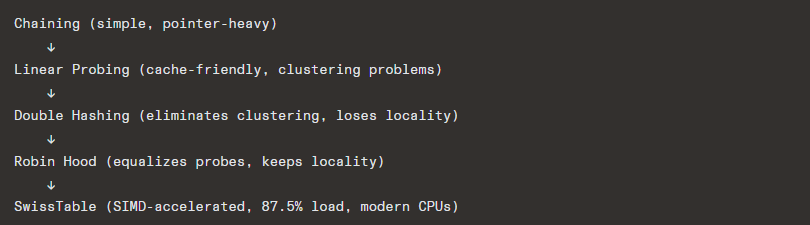
Modern hash tables (SwissTable/hashbrown, Go’s bucket map, Python’s compact dict) are co-designed with CPU architecture — exploiting cache lines, SIMD instructions, and branch prediction to achieve performance that the Big-O notation alone cannot capture.